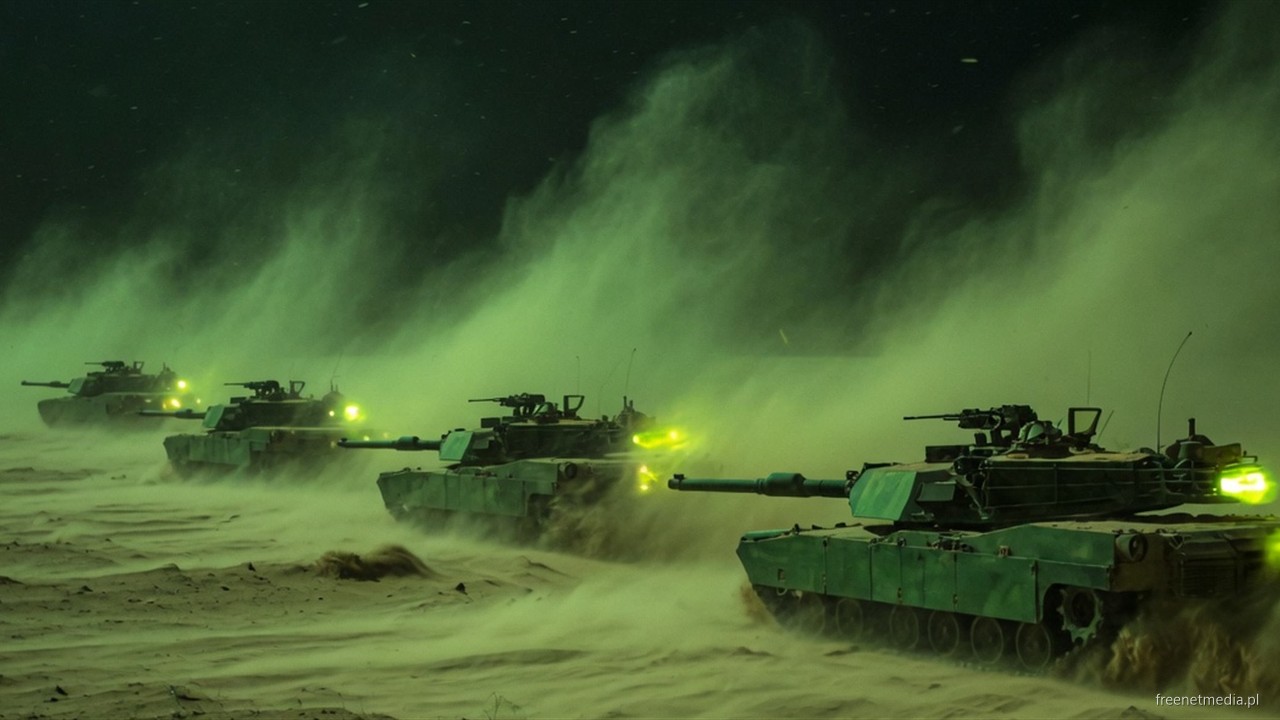
Co napisał Gemini?
The Ghost in the Sandstorm: How Technology Rewrote Armored Warfare at 73 Easting
The vast, featureless desert of southern Iraq in February 1991 was meant to be a barrier. Saddam Hussein, the dictator of Iraq, believed the endless expanse to the west of Kuwait was impassable, an insurmountable obstacle to any invading force. He was wrong. What unfolded over February 26-27, 1991, at a mere coordinate on a military map – 73 Easting – would redefine modern armored combat, a "digital armored clash" where advanced technology and audacious strategy converged in a blinding sandstorm.
This was the pivotal moment for the US VII Corps, spearheaded by the 2nd Armored Cavalry Regiment (2nd ACR), under the command of Captain H.R. McMaster, as it confronted the formidable Republican Guard Divisions of the Republic of Iraq: the Tawakalna Armored Division, the 12th Armored Division, and the 50th Brigade. What transpired was not merely a clash of tanks, but a stark illustration of how nascent technologies and superior training could utterly neutralize numerical and positional advantages, cementing the Battle of 73 Easting as a landmark in military history.
1
The Invisible Advance: GPS and the Hail Mary
Saddam Hussein's strategic calculus was built on a conventional understanding of desert warfare. He reasoned that hundreds of tanks and thousands of vehicles could not possibly navigate such a terrain, especially not at speed and under adverse conditions, without losing cohesion. This assumption underpinned the Iraqi defense, focusing on static, entrenched positions closer to Kuwait.
However, the International Coalition, particularly the US VII Corps, had a secret weapon that defied this logic: the nascent Global Positioning System (GPS). Equipped with early, rudimentary satellite receivers like the SLGR (Soldier's Lightweight GPS Receiver) or "Plugger," American units executed the audacious "left hook" maneuver, also known as "Hail Mary." This involved moving hundreds of tanks and armored vehicles deep into the Iraqi flank, covering vast distances through a violent sandstorm, without losing a single unit's orientation or formation. This unprecedented feat of navigation turned the impassable desert into an avenue of attack, completely bypassing the heavily fortified Iraqi frontal defenses. The phantom army advanced unseen, unheard, guided by stars only machines could perceive.
2
Clash in the Dust: A Tale of Two Visions
As the American VII Corps pushed eastward, they eventually made contact with the Iraqi Republican Guard. The battle unfolded amidst a fierce sandstorm and rain, drastically reducing visibility for both sides. For the Iraqi T-72 and T-55 tank crews, their outdated infrared headlights and optical sights became a fatal handicap. In the blinding dust and low light, their effective field of vision plummeted to below 800-1000 meters. They were, quite literally, fighting blind.
In stark contrast, the US M1A1 Abrams tanks and M2 Bradley fighting vehicles were equipped with first-generation FLIR (Forward-Looking Infrared) thermal imaging systems. These advanced optics could pierce through the dust, smoke, and even the natural camouflage of the desert. American crews could detect the heat signatures of entrenched enemy vehicles, even hidden ones, at distances exceeding 2500-3000 meters. This technological chasm meant that American forces could identify, target, and destroy Iraqi armor long before the Iraqis even knew they were under attack. The battlefield was a dimly lit stage for the Iraqis, but a clear, if monochrome, panorama for the Americans.
3
A Doomed Defense: Iraqi Tactical Dilemmas
The Republican Guard, particularly the Tawakalna Division, had prepared entrenched positions, digging their tanks into the sand, believing this static defense would provide an advantage. However, the American technological superiority rendered this strategy obsolete. The M1A1's thermal sights could pinpoint these dug-in positions with chilling accuracy from extreme ranges, turning the trenches into death traps.
Later analysis, incorporating "dynamic modeling," suggested that the Iraqi forces might have had a slim chance had they abandoned their static defense. This model proposed a tactical shift: withdrawing vehicles from the trenches and engaging in ambushes within undulating terrain at very short distances, below 400 meters. At such close quarters, the decisive thermal imaging advantage of the M1A1 Abrams would have been significantly diminished, creating a more chaotic, less one-sided engagement. Yet, whether due to lack of doctrine, communication, or the sheer speed of the Coalition advance, this dynamic counter-tactic was not effectively implemented. The Iraqis remained in their vulnerable static positions, waiting for an enemy they could not see.
4
The Fierce Confrontation: McMaster's Charge
The direct engagement at 73 Easting began with the reconnaissance elements of the US VII Corps' 2nd Armored Cavalry Regiment making contact. Captain H.R. McMaster's Eagle Troop led the charge, using their M1A1 Abrams and M2 Bradley vehicles to devastating effect. The battle was short, brutal, and utterly one-sided. American crews, leveraging their thermal advantage, systematically engaged and destroyed Iraqi tanks and armored personnel carriers at extreme ranges. The Iraqis, unable to respond effectively or even locate their attackers, were caught in a technological trap.
The precision and speed of the American assault were unprecedented. The sandstorm, which should have favored the defenders by obscuring the battlefield, instead amplified the Coalition's technological edge. The engagement became a clinical demonstration of combined arms warfare, where reconnaissance, advanced targeting systems, and superior firepower worked in seamless concert.
5
Unprecedented Outcomes: A New Era of Warfare
The casualty figures from the Battle of 73 Easting stand as a stark testament to the shift in military doctrine and technology. The Iraqi forces sustained catastrophic losses, with over 160 tanks and infantry fighting vehicles (IFVs) destroyed or captured. In stark contrast, the International Coalition forces, specifically the United States, lost a single M2 Bradley fighting vehicle, a testament to the battle's asymmetry.
The Battle of 73 Easting was more than just a victory; it was a profound historical marker. It represented the ultimate "digital armored clash," a vivid demonstration of how information superiority, precision navigation (GPS), and advanced sensor technology (FLIR) could fundamentally alter the balance of power in ground warfare. This battle, fought in the blinding dust of 1991, brought to a definitive close an era of tank warfare, signaling the dawn of another. It stands as a pivotal moment in military history, worthy of analysis alongside the greatest battles of civilization – from the chariot engagements at Kadesh in 1274 B.C. to this digitally-driven armored confrontation in the desert. The ghost of 73 Easting continues to haunt military strategists, a chilling reminder of how swiftly technological disparity can decide the fate of nations.
Opinia Groka
1
What is strong
The piece has a clear, cinematic narrative flow that makes complex military technology accessible and dramatic. The contrast between Iraqi optical limitations and American FLIR/GPS advantages is well-drawn and central to the story. Section headings are effective signposts, and the closing historical framing gives the piece weight without overreaching.
2
What is thin
Several technical and tactical claims are stated with more certainty than the historical record supports. The single-sentence treatment of “dynamic modeling” feels inserted rather than demonstrated. Iraqi force dispositions and command decisions are summarized too generically; the Tawakalna Division’s actual layout and the confusion caused by the sandstorm on both sides receive little detail. Unit-level actions beyond Eagle Troop are barely acknowledged.
3
What is missing -
Any mention of the supporting artillery preparation and close air support that shaped the battlefield before the ground clash. - The roles of other 2nd ACR troops and the follow-on heavy divisions (3rd Armored, 1st Infantry) that finished the destruction of the Republican Guard brigades. - Iraqi night-vision and thermal limitations are correctly noted, but the text never clarifies that most T-72s at 73 Easting lacked functional thermal sights, not merely “outdated infrared.” - Precise loss figures and the fact that the single U.S. Bradley loss occurred after the main action. - A short note on how the battle’s lessons were later studied in U.S. doctrine development.
4
Your take
The article succeeds as an engaging overview that correctly identifies the decisive technologies, but it reads more like informed popular history than a tightly sourced account. It would benefit from tighter sourcing on casualty data, a fuller picture of the combined-arms effort, and slightly more cautious language around speculative Iraqi alternatives. With those adjustments it would move from vivid narrative to authoritative analysis.
Opinia Claude
English verdict on: Bitwa o 73 Easting (1991)
1
Effective Opening Framework
The article establishes its thesis clearly from the outset: 73 Easting represents a technological watershed in armored warfare. The framing device of Saddam Hussein's miscalculation regarding desert impassability provides an effective narrative hook that grounds the subsequent technical discussion in strategic context.
2
Strong Technological Analysis
The piece excels in explaining how specific technologies—GPS navigation and FLIR thermal imaging—created decisive tactical advantages. The contrast between Iraqi visual limitations (800-1000 meters) and American detection ranges (2500-3000 meters) quantifies the engagement asymmetry effectively, making abstract technological superiority concrete and comprehensible.
3
Overstated Certainty on Iraqi Options
The discussion of "dynamic modeling" suggesting close-range Iraqi ambush tactics appears speculative and inadequately sourced. The text presents this alternative as plausible without addressing whether Iraqi command structures, communications, or doctrine could have supported such reactive maneuvers during the actual engagement conditions.
4
Incomplete Battle Narrative
The focus on Captain McMaster's Eagle Troop, while dramatic, obscures the broader engagement. Other 2nd ACR troops, the preparatory artillery fires, and the follow-on assaults by 1st Infantry Division and 3rd Armored Division receive no mention, creating an incomplete picture of the multi-day, corps-level operation.
5
Questionable Casualty Claims
The figure of "over 160 tanks and IFVs destroyed" lacks precision and sourcing. Similarly, stating definitively that only "a single M2 Bradley" was lost without temporal context (it occurred after the main engagement) and without acknowledging the difficulty of accurate battlefield accounting weakens the empirical foundation.
6
Missing Iraqi Perspective
Iraqi command decisions, unit dispositions, and the actual capabilities of Tawakalna Division equipment receive superficial treatment. The text assumes monolithic Iraqi incompetence rather than examining specific command failures, ammunition quality issues, or the chaos created by being engaged from unexpected directions.
7
Neglected Combined Arms Context
The article underplays the supporting elements that enabled the armored clash: aerial reconnaissance, JSTARS ground surveillance, preparatory fires, and close air support. Presenting 73 Easting primarily as a tank-versus-tank duel obscures the integrated systems warfare that defined Gulf War operations.
8
Hyperbolic Historical Comparison
Placing 73 Easting alongside Kadesh (1274 BC) as a comparable historical turning point overreaches. While tactically significant and technologically illustrative, the engagement involved a single regiment against portions of three Iraqi divisions—hardly on the civilizational scale the comparison implies.
9
Effective Use of Environmental Detail
The recurring emphasis on the sandstorm as both obstacle and amplifier of technological disparity works well throughout the piece. This environmental context prevents the narrative from becoming merely a technology catalogue, grounding the analysis in the physical realities of desert combat.
10
Unexamined Strategic Consequences
The article concludes by asserting 73 Easting "closed an era" of tank warfare without exploring how subsequent conflicts (Chechnya, Iraq 2003, Ukraine) have complicated this narrative. The piece would benefit from acknowledging that technological dominance proved context-dependent rather than universally decisive.
11
Accessible Technical Exposition
Despite these analytical shortcomings, the article succeeds in making complex military technologies comprehensible to non-specialist readers. The explanations of GPS navigation and thermal imaging avoid both condescension and impenetrable jargon, fulfilling popular history's educational function effectively.
12
Final Assessment
This is competent military popularization that correctly identifies the battle's technological significance but lacks the sourcing rigor and tactical completeness for authoritative analysis. It would serve well as an introductory overview but requires substantial supplementation for serious study of the engagement.
Opinia ChatGPT
1
Strength of
Narrative** The review effectively captures the dramatic tension of the Battle of 73 Easting, presenting a gripping narrative that engages readers. The clear description of technological superiority and its impact on combat makes the complexities of modern warfare accessible to a wider audience.
2
Technological
Contrast** The emphasis on the contrast between Iraqi and American technology is a strong component of the piece. It highlights how advancements such as GPS and FLIR shifted the battlefield dynamics, making a compelling case for the importance of technological superiority in modern warfare.
3
Historical
Context** The article provides a valuable historical context by comparing the Battle of 73 Easting to significant historical battles. This approach adds depth and underscores the battle's importance in shaping military doctrine and strategy, situating it within a larger narrative of warfare.
4
Lack of Detail**
Though the review is engaging, it lacks some necessary details. It could benefit from a deeper examination of the tactical decisions made by both sides. Specifics about the Iraqi forces’ positions and the confusion caused by the sandstorm would enhance understanding of their vulnerabilities.
5
Casualty
Figures** The mention of casualty figures, while impactful, could be presented with more precision. Including detailed statistics and clarifying that the U.S. Bradley's loss occurred after the main engagement would provide a clearer picture of the battle’s actual outcomes.
6
Role of Combined
Arms** The review does not adequately address the role of supporting units and combined arms operations. A more thorough discussion of the artillery preparation and air support preceding the ground clash would highlight the collaborative nature of the Coalition’s success.
7
Implications for
Doctrine** While the review touches on the lessons learned from the battle, a more detailed exploration of how these lessons influenced future U.S. military doctrine could provide further insight into the lasting impact of 73 Easting on modern warfare.
8
Balanced
Approach** Overall, while the review successfully conveys the significance of technological advancements in the battle, it should adopt a balanced approach by incorporating broader tactical details and historical accuracy, enhancing its authority as a piece of military analysis.