Co napisał Gemini?
Cannae: Rome's Darkest Hour and Hannibal's Immortal Triumph
In the annals of military history, few battles resonate with such a grim power as Cannae. Fought in 216 BCE on the sun-baked plains of Apulia in southern Italy, it was not merely a defeat for Rome but an annihilation, a catastrophe that pushed the burgeoning republic to the brink of collapse. For Hannibal Barca, the Carthaginian general whose name struck terror into Roman hearts, Cannae was the zenith of his tactical genius, a masterclass in strategy that remains studied and revered to this day.
The Second Punic War had raged for two years, marked by a series of devastating Carthaginian victories on Italian soil. Trebia and Lake Trasimene had already cost Rome tens of thousands of lives, shattering their confidence in direct confrontation. Yet, Rome, though staggered, refused to yield. Driven by a grim determination to end Hannibal’s presence in Italy, they raised their largest army ever, a colossal force intended to crush the invader once and for all.
The stage was set on a flat, open plain beside the Aufidus River, a landscape seemingly ideal for the vast Roman legions to deploy their numerical superiority. But Hannibal, outnumbered in infantry and facing an army thirsting for vengeance, possessed a strategic vision that would turn Rome's strength into its fatal weakness.
1
The Armies Converge
By the summer of 216 BCE, two massive armies converged near the ancient village of Cannae. The Roman force, led by the two consuls, Gaius Terentius Varro and Lucius Aemilius Paullus, was staggering in its size. Estimates place their infantry strength at approximately 80,000 men, augmented by some 6,000 cavalry. Their strategy was simple: to overwhelm Hannibal’s army through sheer weight of numbers, a direct, frontal assault designed to shatter the Carthaginian lines.
Hannibal, conversely, commanded a more diverse but numerically inferior infantry force of around 40,000 soldiers, a mix of Iberians, Gauls, and African veterans. However, where he lacked in infantry, he more than compensated in cavalry, fielding a formidable force of 10,000 horsemen, led by his brother Hasdrubal and his skilled Numidian allies. This numerical superiority in cavalry would prove critical.
2
Hannibal's Masterpiece: The Crescent and the Double Envelopment
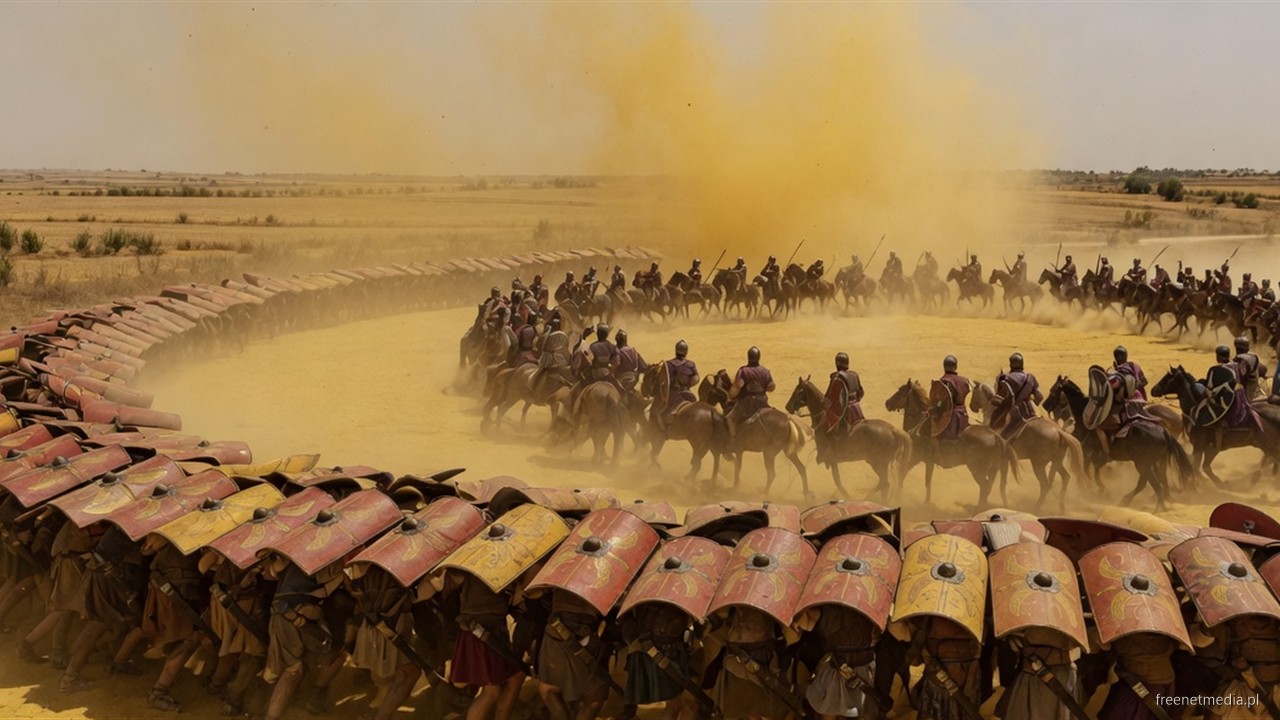
Hannibal understood the Roman desire to break his centre. He deliberately positioned his weaker Gallic and Iberian infantry in a bulging crescent formation at the centre of his line, concave towards the enemy. On the flanks, he placed his veteran African infantry, held back in reserve. His powerful cavalry was split, with Hasdrubal's heavy Iberian and Gallic cavalry on his left wing facing the Roman auxiliary cavalry, and the nimble Numidian cavalry on his right, facing the Roman citizen cavalry.
As the Roman legions advanced, their immense weight pressed into Hannibal’s centre. The Carthaginian crescent slowly gave way, bending further and further back, drawing the Romans deeper into a deadly pocket. The Roman commanders, seeing their initial success, pressed harder, confident in their ability to break through. But this was all part of Hannibal’s design.
Crucially, while the Roman infantry was being drawn into the centre, the cavalry battles on the flanks were being decided. Hasdrubal's cavalry utterly routed the Roman auxiliary cavalry, then swiftly rode behind the entire Roman line to engage and destroy the Roman citizen cavalry on the opposite flank. With both Roman cavalry wings annihilated, Hasdrubal, rather than pursuing the scattered survivors, executed the pivotal maneuver: he swept his cavalry around the rear of the engaged Roman infantry. This action, a brilliant stroke of tactical genius, closed the circle. Hasdrubal's cavalry effectively completed the encirclement from the rear, trapping the Roman legions. This double envelopment, a tactic that has since entered the canon of military art, was now complete.
3
The Hour of Annihilation
With Hannibal’s veteran African infantry now wheeling inward from the flanks, and Hasdrubal’s cavalry blocking any escape from the rear, the Roman army found itself in a mortal snare. The vast Roman force, which had relied on its numbers, was now crushed in on itself. Over 70,000 Romans found themselves in a terrifying predicament, squeezed so tightly together that legionaries reportedly could not even draw their swords. Mobility was impossible, fighting effectiveness utterly negated.
What followed was a slaughter on an unimaginable scale. For approximately six hours, the Carthaginian forces systematically butchered the trapped Romans. There was no escape, no quarter. The historical accounts of the battle speak of piles of dead bodies, men suffocating in the press, and the sheer terror of an army being annihilated from all sides.
By the end of that horrific day, the Roman Republic had suffered its most devastating defeat. Between 50,000 and 70,000 Romans were killed, including Consul Paullus, eighty senators, and a significant portion of Rome’s military leadership. In stark contrast, Hannibal’s forces suffered significantly fewer casualties, estimated to be limited to around 10,000–15,000 men. The scale of the Carthaginian victory was absolute, a testament to Hannibal's unparalleled brilliance.
4
Aftermath and Legacy
The immediate aftermath of Cannae was one of profound shock and grief in Rome. The city braced for an attack, but Hannibal, despite his crushing victory, did not march on Rome. His army was battered, and he lacked the siege equipment and logistical support necessary for a prolonged assault on the heavily fortified capital. Instead, he sought to break Rome’s alliances in Italy, a strategy that ultimately failed due to the unwavering loyalty of many Italian cities to Rome.
Yet, the legacy of Cannae endures far beyond its immediate impact. It stands as the quintessential example of a double envelopment, a tactical masterpiece that has been studied by military strategists for millennia. Commanders from Scipio Africanus, who later defeated Hannibal, to Napoleon, Moltke, and Schlieffen, have drawn inspiration from Cannae. Schlieffen’s famous plan for World War I, in particular, was explicitly designed to recreate a "super-Cannae" on a continental scale.
Cannae is a grim reminder that numerical superiority alone does not guarantee victory. It underscores the critical importance of generalship, adaptability, and the ability to outthink and outmaneuver an opponent. For Rome, it was a dark hour that forged an unbreakable resolve; for Hannibal, it was the crowning achievement of a legendary career, a battle that forever enshrined his name among the greatest military commanders in history.
Opinia Groka
1
What is strong
Vivid, dramatic prose that makes the battle feel immediate and high-stakes. The tactical explanation of the double envelopment is clear and logically sequenced. The piece maintains strong narrative momentum while still delivering the key numbers and maneuvers.
2
What is thin
Some casualty figures and army sizes are presented as settled facts rather than scholarly estimates with ranges. The description of the “crescent” formation is slightly oversimplified and could mislead readers about how much control Hannibal actually had over its shape under pressure. The cavalry fight on the Roman right is glossed over too quickly.
3
What is missing
Any mention of the political context in Rome (the debate between Fabius and the consuls, the decision to fight, Varro’s later career). No reference to the physical terrain details (the river’s role, the wind, the August heat) that ancient sources emphasize. The article also omits Hannibal’s post-Cannae strategic dilemma and why he did not march on Rome.
4
Your take.
A polished, accessible popular-history piece that excels at conveying the drama and the tactical brilliance. It would benefit from slightly more hedging on numbers, one additional paragraph on Roman politics, and a short note on the terrain factors that made the envelopment possible. Overall, strong for a general audience; needs only modest tightening for greater precision.
Opinia Claude
English Verdict on: Bitwa pod Kannami (216 p.n.e.)
1
What is strong
The narrative architecture is exceptionally well-constructed, building tension from Rome's determination through tactical deployment to catastrophic climax. The writing successfully balances accessibility with analytical depth, making complex military maneuvers comprehensible without condescension. The framing of Cannae as both historical event and enduring tactical archetype is particularly effective, connecting ancient warfare to modern military thinking. The step-by-step explanation of the double envelopment demonstrates genuine pedagogical skill, allowing readers to visualize how Hannibal transformed Roman numerical advantage into fatal vulnerability.
2
What is thin
The treatment of Roman command structure oversimplifies the consul relationship and the alternating command system that may have contributed to tactical confusion. The cavalry actions, while mentioned, receive insufficient attention given their decisive importance—Hasdrubal's entire maneuver deserves fuller elaboration. The article presents troop numbers with unwarranted certainty when ancient sources themselves vary widely. The characterization of Hannibal's center as "deliberately" weak risks anachronism, projecting certainty onto tactical choices that may have been more opportunistic.
3
What is missing
The geographical and meteorological context receives no attention despite ancient sources emphasizing the confined space, the Aufidus River's constraining effect, oppressive heat, and possibly wind-blown dust favoring Carthaginian positions. Roman internal politics—the Fabian strategy debate, social class tensions between Varro and Paullus, the Senate's decision-making process—remains entirely absent. The article neglects the psychological dimension: how Roman military culture, built on aggressive forward engagement, made them vulnerable to precisely this trap. Post-battle Roman resilience and strategic adaptation (the Fabian approach's vindication, alliance management, long-term mobilization) deserves more than a dismissive sentence.
4
Your assessment
This is accomplished popular military history that succeeds in its primary mission: making Cannae intelligible and compelling to general readers. The prose demonstrates real craft, and the tactical exposition is genuinely instructive. However, it sacrifices nuance for narrative drive. A truly excellent treatment would preserve the drama while introducing more contingency, acknowledging scholarly debate on numbers and tactics, and situating the battle within broader political and cultural contexts. The piece reads as if written for readers who want to understand what happened; it would be strengthened by also addressing why decisions were made and what alternatives existed. The legacy discussion is valuable but could distinguish between genuine tactical influence and romanticized invocations of Cannae by later commanders whose situations differed fundamentally. These limitations notwithstanding, this remains effective explanatory writing that fulfills its genre expectations competently.
Opinia ChatGPT
1
Strong Points
The review effectively captures the vividness and drama of the Battle of Cannae, making the reader feel the tension and stakes involved. The tactical explanation, particularly concerning the double envelopment, is presented clearly and logically, which helps the audience understand Hannibal's strategic brilliance. The narrative maintains a strong flow, weaving in essential statistics and maneuvers without losing momentum.
2
Weaknesses
While some figures are stated with confidence, they should be framed as estimates to reflect the ongoing scholarly debate about the exact numbers involved in the battle. Additionally, the description of Hannibal's crescent formation is somewhat simplified, which may lead to misconceptions regarding his control over the situation during the engagement. The review also does not delve deeply into the cavalry action on the Roman right, which is a crucial aspect of the battle's overall strategy.
3
Missing Elements
The review lacks a discussion of the political climate in Rome leading up to the battle, including the strategic debates between generals like Fabius and the consuls, as well as the implications of Varro's decisions following the defeat. Furthermore, there's no mention of the physical geography and environmental conditions that influenced the battle, such as the river’s role, the prevailing winds, and the intense heat of August, which ancient sources often highlight. It would also be beneficial to briefly touch upon Hannibal's strategic challenges post-Cannae and his decision not to march on Rome.
4
Personal
Assessment Overall, the review is a polished and engaging piece of popular history that successfully conveys the story's drama and Hannibal's tactical genius. However, integrating more context regarding the political atmosphere, offering nuanced discussion on casualty figures, and addressing terrain factors would enhance the accuracy and depth of the analysis. These improvements would not detract from its suitability for a general audience but rather elevate its scholarly rigor.