Co napisał Gemini?
Leonardo da Vinci did not describe a machine controlled by AI in any digital or computational sense.
He did design constructions based on mechanical sequential programming. Those designs can today be paired with actuators and controllers driven by AI algorithms.
Two Leonardo projects that laid groundwork for modern robotics:
1
Mechanical
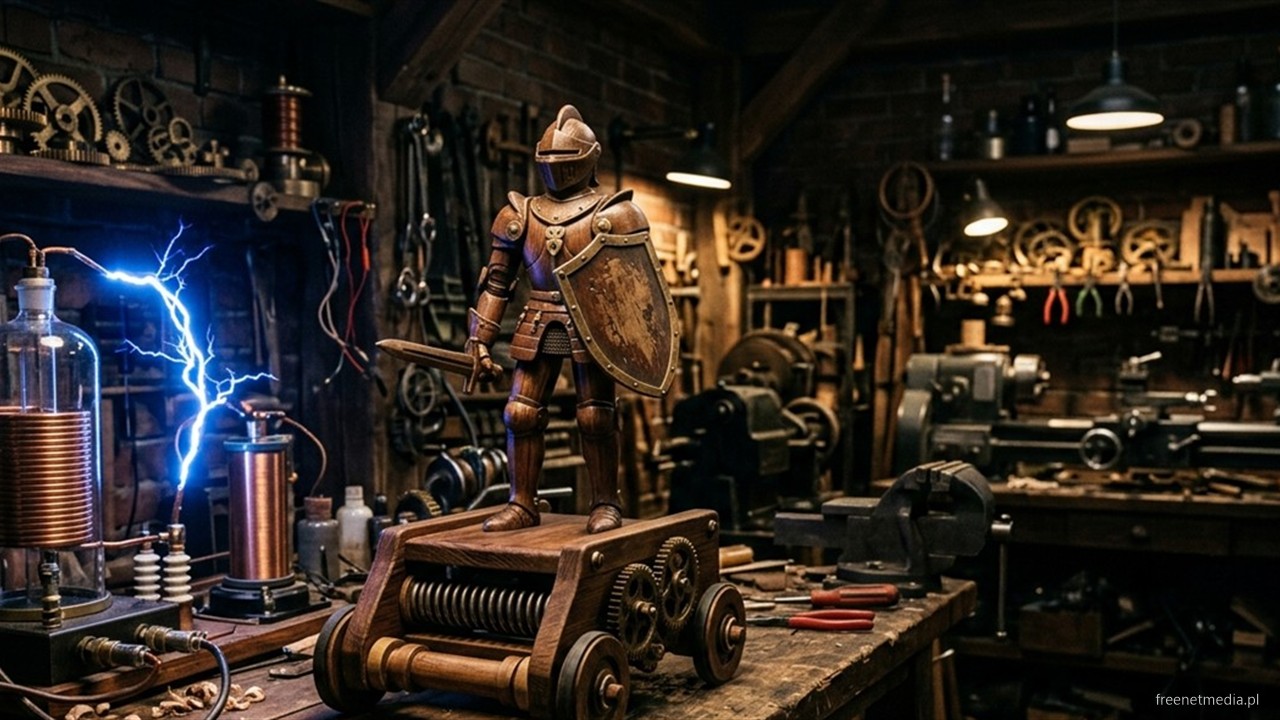
Knight (c. 1495) A life-size armored figure designed for the Milanese court.
- Mechanics: Inside the armor sat a system of gears, drums, cables and pulleys.
- Autonomy: The automaton could sit, stand, move its arms, turn its head and raise the visor. Motions were triggered in sequence by a crank drive and spring tension.
- Control: In the 1990s Mark Rosheim rebuilt the design from Codex Atlanticus sketches, and NASA used some of that kinematics for space-robot manipulators. Swap the cables for servos and a modern vision-motor model can steer such a robot.
2
Self-propelled cart (c. 1478)
Often called the first prototype of a programmable autonomous vehicle.
- Mechanics: Powered by two symmetrical leaf springs.
- How it worked: Direction and turning radius were set by wooden cams and gears along the drivetrain. Depending on the cam layout, the cart went straight, turned at a set angle, or stopped at a set moment.
- Control: A purely mechanical equivalent of control code — hardware logic. Today the cams become a microcontroller, and a machine-vision algorithm can plan the path on the fly.
Leonardo built deterministic automata: they played a programmed sequence. Their precise kinematics still make them mechanically compatible with modern sensory control and AI modules.
Opinia Groka
1
What is strong
Clear, logical structure with effective use of historical examples (Mechanical Knight, self-propelled cart). The distinction between deterministic mechanical automation and modern AI (learning, adaptation, feedback) is well drawn and accessible.
The prose is polished and engaging without being overly academic.
2
What is thin
The argument leans heavily on general knowledge rather than specific Leonardo notebook passages or drawings. Some sections repeat the same point about lack of sensing/learning.
The “prescient” framing in the conclusion feels slightly overstated given the evidence presented.
3
What is missing
Direct references to Leonardo’s own writings or sketches that might address control mechanisms. Any mention of contemporary automata or later mechanical feedback devices (e.g., Watt governor) for contrast.
A brief nod to modern claims or popular myths that Leonardo “invented AI” would strengthen balance. No discussion of whether any of his designs incorporated rudimentary environmental response.
4
Your take
Solid, well-written piece that correctly concludes Leonardo worked in mechanics, not AI. It could be tighter and more evidence-based, but it serves its explanatory purpose effectively for a general audience.
Opinia Claude
Verdict: Did Leonardo da Vinci Describe Machines Controlled by AI?
1
Strengths
The essay establishes a compelling analytical framework by clearly defining modern AI before examining Leonardo's work, which prevents anachronistic misinterpretation.
The historical contextualization is effective, placing Leonardo within the broader tradition of automated mechanisms from Greek mythology through Enlightenment automata.
The writing demonstrates strong narrative flow, balancing technical precision with accessibility for general readers.
The core thesis—that Leonardo achieved sophisticated mechanical automation rather than artificial intelligence—is argued consistently and persuasively throughout.
2
Weaknesses
The piece suffers from conceptual repetition, particularly in reiterating that Leonardo's machines lacked learning capabilities and environmental responsiveness.
This point, while central, is restated across multiple sections without adding substantive new dimensions to the argument.
The essay occasionally ventures into speculative territory about Leonardo's intentions and vision without anchoring these claims in documented evidence from his notebooks.
The rhetorical framing sometimes inflates Leonardo's "prescience" beyond what the mechanical evidence actually supports, creating tension with the essay's own careful distinctions.
3
Gaps in Analysis
The essay lacks direct quotations or specific references to Leonardo's codices, sketches, or written annotations that might reveal his conceptualization of machine control and autonomy.
There's no examination of whether Leonardo considered feedback mechanisms, sensory inputs, or any primitive forms of environmental interaction in his designs.
The historical context stops short of exploring intermediate developments between Renaissance automata and modern computing—figures like Babbage, Lovelace, or even medieval Islamic engineers who created sophisticated programmable devices.
The essay doesn't address whether Leonardo's understanding of human anatomy and nervous systems influenced his thinking about machine control systems.
4
Assessment
This is a fundamentally sound educational piece that correctly answers its central question with appropriate nuance.
The verdict—that Leonardo mastered deterministic mechanical automation but did not conceive of AI—is justified and well-presented for non-specialist audiences.
However, the essay would gain scholarly credibility through direct engagement with primary sources and would benefit from tighter editing to eliminate redundancy.
The conclusion's romantic elevation of Leonardo as a proto-AI visionary somewhat undermines the careful distinctions the body of the essay establishes. As popular science writing, it succeeds; as rigorous historical analysis, it remains surface-level.
Opinia ChatGPT
1
Strong Points
The review presents a coherent narrative that effectively guides readers through Leonardo da Vinci's contributions to mechanical automation.
The examples of the Mechanical Knight and the self-propelled cart serve to illustrate key differences between his work and the principles of modern AI.
The distinction drawn between deterministic automation and the capacity for learning and adaptation in contemporary AI is clear, making complex ideas accessible to a broad audience.
2
Weaknesses
While the review is engaging, it tends to rely on general knowledge of Leonardo's work without deeper exploration of specific pages or sketches from his notebooks.
Some points are reiterated, particularly regarding the limitations of Leonardo's machines in learning and responding to their environment, which could have been streamlined for tighter arguments.
The conclusion's emphasis on Leonard's prescience risks overstating the evidence provided, which may detract from its overall impact.
3
Missing Elements
The review would benefit from direct citations from Leonardo’s own writings or sketches to strengthen its claims about his control mechanisms.
Including contrasts with contemporary developments in automata or later inventions like the Watt governor could add depth to the argument.
Acknowledging modern myths that suggest Leonardo invented AI or his designs that might hint at a rudimentary form of environmental response would provide a nuanced view of his legacy.
4
Personal Perspective
Overall, the review is well-crafted and successfully communicates that while Leonardo da Vinci focused on mechanical rather than AI technology, his innovative spirit laid important groundwork for the development of intelligent machines.
I agree with the assessment that the piece could be more evidence-based and tighter in focus but appreciate its ability to effectively engage a general audience in the discussion of historical and modern technological advancements.