Co napisał Gemini?
The vast, undulating plains of the Russian steppe had, by the summer of 1943, become synonymous with the largest and most brutal land war in human history. Twice before, in 1941 and 1942, the German Wehrmacht had launched colossal offensives, pushing deep into Soviet territory. Yet, each time, the tide had turned, leaving a trail of destruction and mounting casualties. Now, as the warm July sun beat down on a bulge in the Eastern Front around the city of Kursk, a third, and ultimately decisive, clash was brewing. This was the Battle of Kursk, or “Operation Citadel” as it was known to the Germans, a titanic struggle that would span from July 5 to August 23, 1943, and irrevocably alter the course of World War II.
The Kursk salient, a roughly 200 km wide and 150 km deep protuberance into German lines, presented an irresistible target for Hitler's forces. For the Wehrmacht, it was an opportunity to cut off a substantial Soviet force, stabilize the front, and perhaps regain the strategic initiative lost after Stalingrad. For the Red Army, it was a moment of truth, a test of whether they could not only hold but decisively defeat the German war machine.
1
The Eastern Front's Shifting Sands and Soviet Preparedness
The early years of the Eastern Front had been marked by devastating Soviet surprises, often caught unaware by the lightning speed and tactical ingenuity of the German blitzkrieg. But by 1943, the tables had turned in a crucial respect. Unlike the intelligence blind spots of 1941 or 1942, under the Kursk salient, the Red Army possessed an almost uncanny understanding of what their adversary was planning. German intentions, troop movements, and even the precise timing of their offensive were known to the Soviet high command, the Stavka.
This invaluable intelligence allowed for a radical shift in Soviet strategy. Marshal Georgy Zhukov and Marshal Aleksandr Vasilevsky, key figures in the Soviet war effort, successfully convinced Stalin to reject the tempting impulse to attack first. Instead, they advocated for a strategic defense – an audacious plan to absorb the German assault, bleed their armored divisions dry, and then unleash a crushing counteroffensive. What followed was an engineering marvel, a testament to the sheer scale of Soviet mobilization: the preparation of the deepest system of fortifications ever conceived.
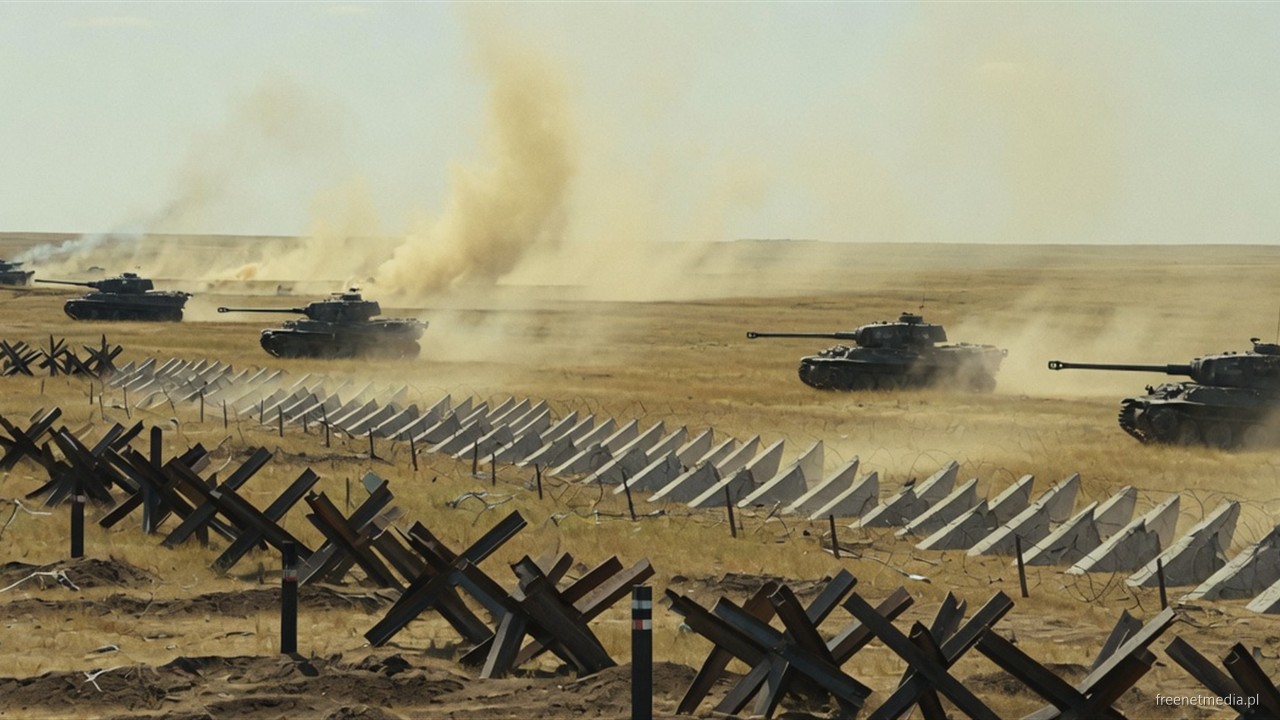
Stretching up to 150 km deep, these defensive belts comprised eight successive lines, meticulously constructed with trenches, anti-tank ditches, artillery strongpoints, and machine-gun nests. Crucially, the terrain was sowed with a deadly harvest of mines, reaching an astonishing density of up to 2,500 anti-tank and anti-personnel mines per kilometer of front. This was not merely a defense; it was a vast, layered trap designed to ensnare and destroy the cream of the Wehrmacht's armored formations.
As the German troops finalized their preparations on the northern shoulder of the salient, Soviet General Konstantin Rokossovsky received critical intelligence. Thanks to captured sappers, he knew the exact hour of the imminent German assault. At 02:20 in the morning, a full 100 minutes before the Wehrmacht's scheduled H-hour, Rokossovsky unleashed a powerful preemptive artillery barrage. Over 600 guns and Katyusha rocket launchers rained down fire on the forward positions of Model's 9th Army, inflicting immediate losses and, more importantly, triggering a shock that paralyzed German command for several crucial hours. This unexpected storm of steel disrupted communications, delayed the advance, and shattered German morale even before their panzers had begun to roll.
2
The Clash of Steel: Prohorovka and the Southern Front
While the German offensive in the north struggled against Rokossovsky's well-prepared defenses and preemptive strike, Field Marshal Erich von Manstein's southern thrust initially achieved greater success. Here, the formidable II SS Panzer Corps – comprising the elite Leibstandarte, Das Reich, and Totenkopf divisions under the command of Paul Hausser – spearheaded the attack. These highly motivated and well-equipped units managed to penetrate deeper into the Soviet lines, pushing approximately 35 km and setting their sights on the crucial railway junction of Prohorovka.
It was near Prohorovka, on July 12, 1943, that the Battle of Kursk reached its terrifying crescendo in one of the largest tank battles in history. As Manstein’s armored spearhead pressed forward, General Pavel Rotmistrov's Soviet 5th Guards Tank Army was hurled into a direct, frontal counterattack. Over 600 to 800 Soviet tanks, primarily T-34s and lighter T-70s, surged forward, meeting the German panzers head-on in a chaotic, close-quarters engagement across the rolling fields.
The battle for Prohorovka was a brutal slugfest. The Red Army suffered drastic tactical losses, with over 300 machines destroyed in a single day compared to just several dozen German tanks. The sheer weight of numbers and the ferocity of the Soviet attack, however, achieved its strategic objective. Manstein's armored wedge, though inflicting heavy casualties, was irrevocably halted. Critically, waiting in reserve was Marshal Ivan Konev’s untouched Soviet Steppe Front, a massive formation of approximately 500,000 men and 1,500 tanks, ready to be committed if the German advance had broken through. The road to Kursk was not open, and Manstein’s illusion was shattered.
Beyond the raw courage and strategic acumen, Kursk also exposed critical technological weaknesses within the Wehrmacht. The battle marked the combat debut of the vaunted Panther tank, touted as Germany's answer to the T-34. Of the 200 Panther tanks deployed, a significant number broke down mechanically or even caught fire due to severe defects in their cooling systems and transmissions, often before they even reached their starting lines. Had modern digital fatigue tests of the HL 230 engines and Panther transmissions been available, they would have predicted a failure rate exceeding 70% within the first 50 km of travel, a data point that might have eliminated Hitler's ill-fated decision to hinge an entire operation on unproven vehicles. Similarly, a modern C4ISR system would have immediately identified the presence of Konev's hidden Steppe Front behind the salient, stripping away any lingering German hope of a swift breakthrough.
The Battle of Kursk stands as a monumental turning point in World War II. It marked the definitive end of German offensive capability on the Eastern Front. After Kursk, the Wehrmacht would be permanently on the defensive, slowly but inexorably pushed back towards Berlin. The Red Army, through a combination of superior intelligence, strategic patience, deep defensive planning, and sheer will, had demonstrated its capacity not only to resist but to utterly defeat the German military machine. The vast fields around Kursk, once a battleground of steel and fire, became the burial ground for Hitler's last hopes of victory in the East, paving the way for the ultimate Allied triumph.
Opinia Groka
1
What is strong
Vivid, cinematic prose that effectively conveys scale and drama. Strong emphasis on Soviet intelligence, defensive depth, and the strategic decision to absorb then counterpunch. The section on Rokossovsky’s preemptive barrage is well-chosen and adds tension. The overall arc clearly frames Kursk as the end of German offensive power on the Eastern Front.
2
What is thin
Tactical details at Prokhorovka are oversimplified and lean on the old “largest tank battle” myth; actual engagement was smaller and more fragmented than portrayed. The Panther reliability critique feels grafted on rather than integrated. Casualty and force ratios are vague or selectively dramatic. The southern thrust receives almost all the attention while the northern (Model) sector is mentioned only briefly.
3
What is missing
Air operations and the Luftwaffe’s role. The northern pincer’s fighting around Ponyri and Olkhovatka. Overall casualties and equipment losses for both sides. The immediate follow-on Soviet offensives (Operation Kutuzov and Rumyantsev) that actually exploited the victory. A short note on how Soviet deep-battle doctrine evolved from this experience.
4
Your take.
Solid popular-history narrative that captures the strategic turning point and Soviet preparation well, but it sacrifices precision for drama and would benefit from tighter tactical grounding plus a wider lens on both sectors and the air battle. The modern-tech asides break the historical tone and should be removed or reframed.
Opinia Claude
English verdict on: Bitwa na Łuku Kurskim (1943)
1
What is strong
The opening establishes atmospheric context effectively, placing Kursk within the broader arc of the Eastern Front's evolution. The emphasis on Soviet intelligence superiority and the deliberate choice to defend-then-counterattack represents sound strategic analysis. The description of the defensive preparations—eight successive belts, 150km deep, with extraordinary mine density—conveys the unprecedented scale of Soviet engineering. The narrative rightly identifies this as the terminal point of Wehrmacht offensive capability in the East, and the prose maintains consistent energy throughout.
2
What is weak
The Prokhorovka account perpetuates the "largest tank battle" mythology without acknowledging scholarly revisions that show a more scattered, less decisive engagement. Numbers fluctuate imprecisely (600-800 tanks, "several dozen" German losses) where more exact figures exist. The Panther reliability discussion, while factually interesting, intrudes awkwardly with its hypothetical modern-testing digression that breaks historical tone. The northern sector under Model receives cursory treatment despite representing half the offensive effort. The piece conflates tactical disappointment with strategic failure at Prokhorovka in ways that obscure what actually stopped Manstein: Allied landings in Sicily and Hitler's order to disengage, not battlefield exhaustion alone.
3
What is missing
Air power receives no attention, despite the Luftwaffe's initial superiority and subsequent Soviet dominance being critical to ground operations. The piece omits Vatutin's role commanding the Voronezh Front in the south. There's no mention of the immediate Soviet counteroffensives—Operations Kutuzov and Polkovodets Rumyantsev—that actually transformed defensive success into territorial reconquest. Casualty figures for both sides are absent, leaving the human cost abstract. German logistical constraints and fuel shortages, which hampered mobility as much as Soviet resistance, go unmentioned.
4
Your assessment
This reads as competent popular history: engaging, dramatically structured, and correct in broad outline about Kursk's significance as a turning point. However, it sacrifices granularity for sweep and relies on dated interpretations of Prokhorovka that recent scholarship has complicated. The narrative would gain authority by acknowledging the northern battle more fully, integrating air operations, and tracing the immediate aftermath that converted defensive victory into offensive momentum. The modern-technology asides damage rather than enhance the analysis and should be excised entirely. As an introduction for general readers, it succeeds; as rigorous historical assessment, it requires tightening and expansion in equal measure.
Opinia ChatGPT
1
Strengths
The narrative effectively immerses the reader in the vastness and intensity of the Battle of Kursk, employing vivid imagery that captures the chaos and scale of the conflict. The focus on Soviet intelligence and defensive preparations is particularly compelling, highlighting a significant strategic advantage that altered the course of the battle. The depiction of Rokossovsky's preemptive strike is an excellent choice that emphasizes the element of surprise and skillful planning executed by the Soviet leadership. Overall, the framing of Kursk as the culminating point of German offensive capabilities on the Eastern Front is well articulated and impactful.
2
Weaknesses
While the writing resonates with drama, it simplifies some tactical aspects of the battle, especially the engagement at Prohorovka. The portrayal of this being a "largest tank battle" narrative glosses over the more nuanced and fragmented nature of the actual skirmishes. Additionally, the critique on the Panther tank's reliability feels somewhat detached from the overall narrative and could have been integrated more cohesively. The emphasis on southern thrust tactics overshadows the northern sector's operations, which are mentioned only peripherally.
3
Missing Elements
There is a noticeable absence of discussion surrounding the Luftwaffe’s contributions and air operations during the battle, which played a significant role in support and logistics. Important details about the northern pincer engagements, such as fighting around Ponyri and Olkhovatka, are also lacking. A breakdown of overall casualties and losses on both sides would provide a clearer picture of the battle's ramifications. Furthermore, the follow-on Soviet offensives, namely Operation Kutuzov and Rumyantsev, which capitalized on the momentum gained at Kursk, are omitted, as is a reflection on how the experiences from this battle influenced the development of Soviet deep battle doctrine.
4
Personal
Assessment The piece serves as a spirited account of a pivotal moment in World War II, effectively illustrating the strategic undercurrents and preparations that defined the Battle of Kursk. Nonetheless, its inclination towards dramatic storytelling occasionally compromises the precision and factual robustness expected in historical analysis. Broadening the scope to include various sectors, aerial perspectives, and follow-up consequences would elevate its depth. Moreover, the modern technological commentary should be reframed or omitted to maintain historical integrity and coherence within the narrative.