Co napisał Gemini?
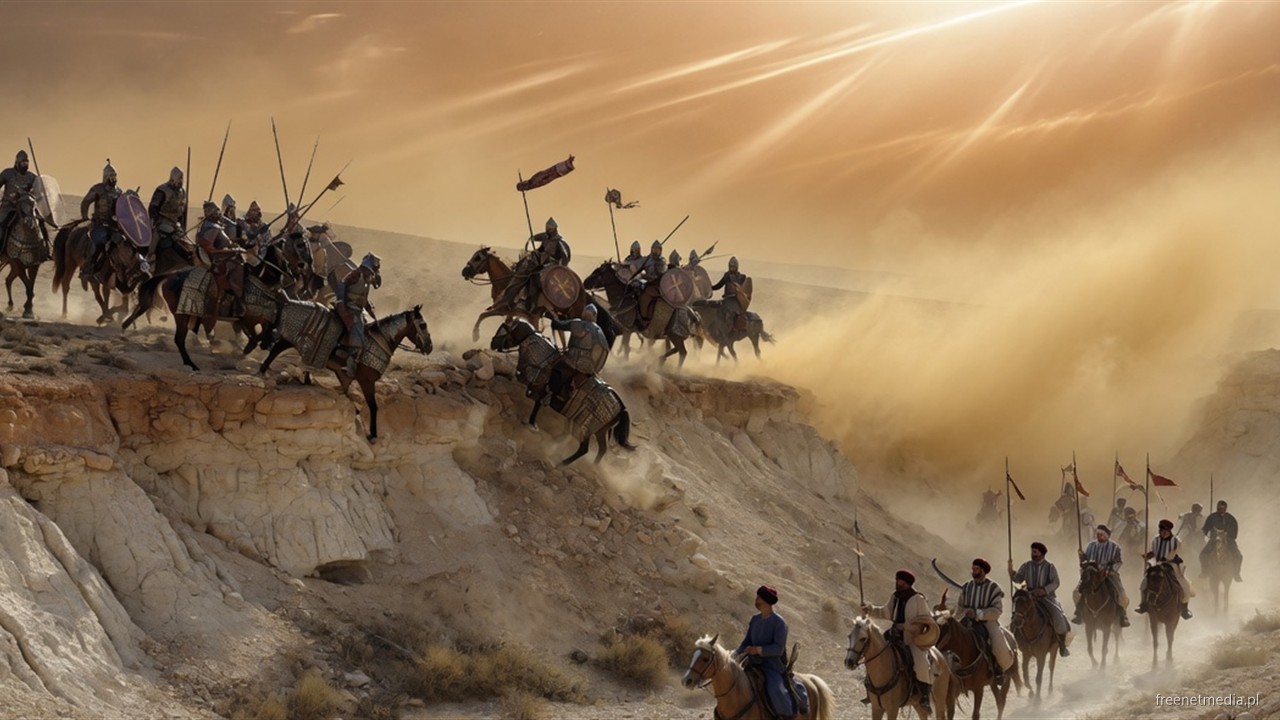
The scorching sun beat down on the Syrian plains in the summer of 636 AD, baking the earth into a dusty, cracked canvas. But beneath the relentless glare, a drama of epic proportions was about to unfold, one that would redefine the geopolitical landscape of the Middle East and cast a long shadow over the future of empires. Here, at the banks of the Yarmouk River, the nascent Muslim Caliphate would clash with the mighty Byzantine Empire in a confrontation of wills, strategy, and faith – a battle known to history simply as Yarmouk.
The Byzantine Empire, inheritor of Rome's glory, had for centuries been the dominant power in the Eastern Mediterranean. Its armies, disciplined and well-equipped, were a formidable force. Yet, from the sands of Arabia, a new power had emerged with astonishing speed, fueled by the teachings of Islam and led by commanders of unparalleled genius. The fate of Syria, and indeed much of the world, hung in the balance.
1
A Clash of Empires: The Stakes at Yarmouk
The early 7th century was a period of profound upheaval. The Byzantine Empire, though recently victorious against its long-standing Persian rival, was exhausted. Its provinces in the Levant, particularly Syria, were rich but vulnerable. Into this power vacuum burst the Rashidun Caliphate, an Islamic state expanding rapidly from its Arabian heartland. Muslim armies had already achieved significant victories, capturing Damascus and challenging Byzantine authority across the region. Emperor Heraclius, recognizing the existential threat, resolved to crush this new menace decisively. He amassed a colossal army, drawing troops from across his vast domain, including Armenian, Ghassanid Arab, and Slavic contingents, intending to sweep the Muslims back into the desert from whence they came.
The Muslim forces, under the overall command of Abu Ubaidah ibn al-Jarrah but effectively led on the battlefield by the brilliant strategist Khalid ibn al-Walid, had retreated to the plains of Yarmouk. Khalid, famously dubbed "The Sword of Allah" by Prophet Muhammad himself, understood the gravity of their position. Outnumbered significantly, his genius would be put to the ultimate test.
2
The Sword of
Allah vs. Imperial Might
The numerical disparity at Yarmouk was staggering. Khalid ibn al-Walid commanded a force estimated between 25,000 and 40,000 fighting men. Arrayed against them was the imperial Byzantine army, a behemoth believed to number between 80,000 and 100,000 soldiers. This vast host, under the command of Theodoros Trithyrios (brother of Emperor Heraclius) and Vahan, an Armenian general, was designed to overwhelm through sheer weight of numbers.
However, Khalid possessed advantages beyond simple headcounts. His army, though smaller, was cohesive, highly motivated, and composed predominantly of battle-hardened veterans. Crucially, he had honed their mobility and discipline, particularly that of his elite cavalry. He understood that against such overwhelming numbers, conventional tactics would lead to certain defeat. His strategy would instead rely on an intricate dance of feint and counter-attack, exploiting weaknesses and leveraging the very terrain they fought upon.
3
The Unforgiving Landscape: Yarmouk's Strategic Stage
The battlefield itself was a key player in Khalid's strategy. The Yarmouk River plain was bordered on the west by the deep ravines of Wadi al-Raqqad and on the east by Wadi al-Allan, both impassable for large armies. To the north lay a strategically important bridge over Wadi ar-Raqqad, the only viable escape route to the west for the Byzantine army, leading to the Golan Heights and onward to Damascus. The terrain was broken and uneven, dotted with hills and ravines, which Khalid knew could be used to channel enemy movements and conceal his own.
Khalid meticulously positioned his forces, ensuring that his flanks were protected by the wadis. This meant the Byzantine army, despite its superior numbers, could not easily outflank the Muslim lines. Instead, they were funneled into a relatively narrow engagement area, where their numerical advantage would be mitigated, and where Khalid's tactical prowess could shine. The Byzantines, perhaps overconfident in their numbers, failed to adequately secure their rear, a mistake that would prove catastrophic.
4
The Mobile Guard: Khalid's Masterstroke
The battle commenced with several days of intense, seesaw fighting. The Byzantine army launched repeated, powerful assaults, particularly on the Muslim center and flanks. Their heavy infantry, supported by archers, sought to shatter the Muslim lines. Time and again, the Muslim forces found themselves pushed to the brink, their formations buckling under the immense pressure.
It was during these critical moments that Khalid's tactical genius, and the effectiveness of his "Mobile Guard," became evident. This formidable contingent, consisting of approximately 4,000 elite cavalry, was Khalid's personal reserve, a striking force capable of rapid deployment. Positioned behind the main lines, the Mobile Guard acted as a rapid-response unit, constantly shifting across the battlefield. Whenever a Byzantine assault threatened to break through a Muslim sector, Khalid would personally lead elements of the Mobile Guard in a thunderous counterattack. These charges, launched into the exposed flanks of the advancing enemy, restored stability to the Muslim front, buying time for the main lines to regroup and preventing any catastrophic collapse. This extraordinary flexibility and decisive intervention kept the Muslim army intact despite the relentless Byzantine pressure.
5
The Fifth Night: A Dagger in the Dark
As the fifth day of fighting drew to a close, both armies were exhausted, but the Byzantines still held the numerical advantage. Yet, Khalid had been patiently waiting for his moment. Under the cloak of darkness on the night leading into the sixth day, he initiated a daring and decisive maneuver. He dispatched a specialized force of 500 elite cavalry, commanded by the experienced Zubayr ibn al-Awwam, with a singular, crucial objective: to seize and hold the bridge over the deep Wadi ar-Raqqad.
This bridge was no mere crossing; it was the Byzantines' sole viable escape route to the west. From a modern analytical perspective, an algorithm assessing the battlefield would have identified this bridge over Wadi ar-Raqqad as a point of 100% criticality – a Single Point of Failure (SPOF) for the Byzantine army. Such an analysis would have unequivocally recommended a permanent defensive redoubt, bolstered by engineering units, to secure this vital artery. However, the Byzantines, perhaps complacent or underestimating their nimble foe, had left it inadequately guarded.
Had the Byzantines anticipated Khalid's audacity and intercepted Zubayr's 500-man raid during that fateful fifth night, Khalid’s encirclement maneuver would have been neutralized, and their safe route of retreat to the west would have remained open. But they did not. Zubayr’s contingent successfully seized the bridge, effectively severing the Byzantine army's primary avenue of escape and sealing their fate.
6
Annihilation: The Sixth Day and Its Aftermath
With their escape route cut off by a mere 500 cavalrymen under the cover of night, the Byzantine army found itself in a death trap. As the sun rose on the sixth day, Khalid unleashed a ferocious, coordinated assault. Panic began to spread through the Byzantine ranks, particularly once the news of their cut-off retreat permeated the lines. The Muslim cavalry, now unleashed, pressed hard, driving the Byzantines towards the impassable ravines and the now-controlled bridge.
The ensuing rout was a massacre. Thousands of Byzantine soldiers, caught between the relentless Muslim advance and the deep wadis, desperately tried to escape. Many plunged into the ravines, while others were cut down by the pursuing Muslim cavalry. The annihilation was total. Of the vast Byzantine host, an estimated 40,000 to 70,000 soldiers were killed, a casualty figure that speaks to the sheer scale of the disaster. The imperial army was, to all intents and purposes, utterly destroyed.
7
A Legacy Forged in Blood and Sand
The Battle of Yarmouk in 636 AD was more than just a military victory; it was a watershed moment in history. The destruction of the main Byzantine army in Syria paved the way for the rapid Muslim conquest of the Levant. Within a few years, Jerusalem, Antioch, and other key cities fell, forever changing the demographic and religious fabric of the region.
Khalid ibn al-Walid's tactical brilliance, his audacious use of a numerically inferior force, his masterful deployment of light cavalry, and his decisive night maneuver to seize the critical bridge at Wadi ar-Raqqad, cemented his place as one of history's greatest military commanders. Yarmouk shattered Byzantine power in the East, opened the gates to Islamic expansion, and laid the foundations for a new civilization that would flourish for centuries. The echoes of that fateful summer day on the banks of the Yarmouk continue to resonate, a testament to the power of strategy, leadership, and the relentless march of history.
Opinia Groka
1
What is strong
Vivid, cinematic prose that makes the battle feel immediate and high-stakes. The tactical focus on Khalid’s use of terrain, the Mobile Guard’s role, and the seizure of the bridge is clear and well-paced. The numbered sections give the piece a clean, readable structure.
2
What is thin
Some numerical claims (80–100k Byzantines) are presented as fact when they are heavily disputed by historians. The modern “Single Point of Failure” framing appears abruptly and breaks the historical tone. The five days of fighting are summarized rather than shown, so the seesaw nature of the battle feels asserted rather than demonstrated.
3
What is missing
A brief note on source problems and the wide range of scholarly estimates for both armies. Any mention of Byzantine dispositions or command decisions beyond “overconfidence.” A short paragraph on the immediate strategic consequences (fall of Damascus, Jerusalem, etc.) to ground the “legacy” section. A single sentence acknowledging that much of the dramatic detail comes from later Arabic chronicles rather than contemporary accounts.
4
Your take
The piece is a strong popular-history narrative that successfully highlights Khalid’s operational skill, but it would benefit from tighter sourcing discipline and the removal of the anachronistic business-school metaphor. With those adjustments it would read as both dramatic and credible.
Opinia Claude
English verdict on: Bitwa pod rzeką Jarmuk (636)
1
Narrative Power and Engagement
The Gemini text delivers an exceptionally vivid reconstruction of the Battle of Yarmouk, employing cinematic language that transforms dry military history into gripping drama. The opening paragraph's description of the "scorching sun" and "dusty, cracked canvas" immediately establishes atmosphere, while phrases like "The Sword of Allah" and "drama of epic proportions" inject appropriate gravitas. The numbered structure creates natural reading breaks and allows complex tactical concepts to unfold methodically. The progression from context through strategy to outcome follows a logical arc that serves both casual readers and those seeking deeper understanding.
2
Tactical Analysis and Military Detail
The piece's greatest strength lies in its explanation of Khalid ibn al-Walid's tactical genius. The description of the Mobile Guard as a 4,000-strong rapid-response cavalry force effectively illustrates medieval combined-arms warfare. The geographical analysis—positioning wadis as force multipliers that negated Byzantine numerical superiority—demonstrates sophisticated military thinking. The night raid on the bridge emerges as the narrative's climactic turning point, properly emphasizing how a 500-man detachment achieved strategic effects disproportionate to its size. This focus on operational art rather than mere chronology elevates the account beyond simple battle description.
3
Anachronistic Intrusions
The "Single Point of Failure" terminology and algorithmic analysis language in section five represents a jarring tonal shift. Phrases like "an algorithm assessing the battlefield" and "100% criticality" import modern business-school jargon into seventh-century Syria, undermining the otherwise consistent historical voice. While the analytical point about the bridge's importance is valid, framing it through contemporary corporate risk-management concepts feels forced and diminishes the period authenticity carefully built elsewhere. This modernization adds nothing that couldn't be conveyed through period-appropriate strategic language.
4
Source Transparency Issues
The text presents contested figures as established fact without qualification. Troop estimates ranging from 25,000 to 100,000 represent historiographical debates spanning centuries, yet the narrative offers them with false precision. No mention appears of the problematic source base—primarily later Arabic chronicles written generations after the event, often with hagiographic intentions regarding early Islamic commanders. The lack of any historiographical hedging ("estimates suggest," "sources claim") creates an impression of certainty that serious scholarship on early Islamic conquests actively disputes.
5
Byzantine Perspective Deficit
The Byzantine side remains curiously underdeveloped beyond serving as a vast, faceless opponent. The command structure receives minimal attention—Theodoros Trithyrios and Vahan are named but never characterized. No explanation appears for why experienced Roman commanders would leave their sole retreat route undefended, reducing Byzantine generalship to mere "overconfidence." The religious and political context within the Byzantine Empire—exhaustion from Persian wars, theological divisions, local Syrian discontent with Constantinople—receives only cursory mention, yet these factors critically shaped Byzantine military effectiveness and local populations' receptiveness to new rulers.
6
Geographical and Strategic Context
The terrain description excels, particularly the explanation of how Wadi al-Raqqad and Wadi al-Allan functioned as force multipliers. However, the broader strategic picture remains incomplete. Why did Heraclius stake everything on this single confrontation rather than pursuing a defensive withdrawal strategy? What logistical considerations constrained both armies in the Syrian summer heat? How did Muslim control of Arabia's interior lines of communication advantage their operations? These larger operational questions would contextualize why Yarmouk became decisive rather than merely another border skirmish.
7
Long-Term Impact Assessment
The concluding legacy section appropriately identifies Yarmouk as a civilizational turning point but rushes through consequences that deserved fuller treatment. The subsequent fall of Jerusalem, the collapse of Byzantine Syria and Palestine, and the eventual Muslim conquest of Egypt and North Africa all stemmed from this battlefield outcome. The religious transformation of the Levant—from predominantly Christian to predominantly Muslim over subsequent centuries—represents perhaps the battle's most enduring consequence, yet receives only passing mention. A paragraph exploring how this military decision fundamentally reshaped Mediterranean civilization would strengthen the piece's historical weight.
8
Overall Assessment
This represents accomplished popular military history that successfully explains complex tactical concepts to general audiences. The narrative drive never falters, and Khalid's strategic brilliance receives proper emphasis. However, the text would benefit from clearer acknowledgment of source limitations, removal of anachronistic business terminology, and more balanced treatment of Byzantine decision-making. The piece works well as dramatic reconstruction but requires tighter scholarly discipline to fully succeed as historical analysis. With modest revisions addressing these concerns, it could serve as an exemplary model of accessible yet rigorous military history writing.
Opinia ChatGPT
1
Strength of the
Narrative** The review excels in its vivid and cinematic storytelling, effectively immersing readers in the dramatic atmosphere of the Battle of Yarmouk. The detailed description of the battlefield conditions and the strategic maneuvers employed by Khalid ibn al-Walid creates a sense of immediacy and stakes that captivates the audience. The structure provided by the numbered sections enhances readability and allows for a clear progression of events and strategies.
2
Concerns
Regarding Historical Accuracy** While the narrative is engaging, it includes some numerical estimates regarding the sizes of the opposing forces that are more contested than presented. Historians continue to debate the exact troop figures for both sides, and presenting them as definitive could lead to misconceptions. The sudden introduction of modern terminologies, such as "Single Point of Failure," disrupts the historical tone and may alienate some readers who expect a consistent period-specific context.
3
Omissions
Worth Considering** The review could benefit from acknowledging the challenges in source material, particularly the discrepancies in accounts from Arabic chronicles as opposed to contemporary sources. Furthermore, including a brief discussion of the Byzantine command structure and strategic decisions beyond mere overconfidence would enrich the analysis. Additionally, a mention of the immediate consequences of the battle, such as the fall of key cities like Damascus and Jerusalem, would help contextualize its significance historically.
4
Overall Impression**
This analysis presents a compelling and dramatic overview of Khalid’s military acumen and the pivotal nature of the Battle of Yarmouk. However, it would be improved by incorporating a more nuanced understanding of the historical uncertainties surrounding troop numbers, source reliability, and deeper exploration of the Byzantine strategic landscape. Addressing these elements would contribute to a narrative that is not only thrilling but also credible and well-rounded.