Co napisał Gemini?
The Two-Hour Cataclysm: Mohács, 1526, and the Fate of Central Europe
In the annals of European history, few battles, despite their brevity, carry the seismic significance of the Battle of Mohács. Fought on August 29, 1526 CE, this encounter lasted "zaledwie około dwóch godzin, lecz jej skutki zaważyły na losach Europy Środkowej na ponad 150 lat." It was a clash that dramatically reshaped the political landscape, ushering in an era of Ottoman dominance that would cast a long shadow over the continent.
1
A Gathering Storm: The Ottoman Advance
The first quarter of the 16th century saw the Ottoman Empire reach the zenith of its power under the formidable rule of Sultan Suleiman the Magnificent. Driven by an ambition to expand his burgeoning empire into the heart of Europe, Suleiman launched a massive campaign targeting the Kingdom of Hungary. Leading an immense army of "ponad 60 000–80 000 zbrojnych," comprising elite Janissaries, formidable cavalry, and a state-of-the-art artillery train, Suleiman's march north was a clear and present danger to the Christian states of Central Europe.
2
Hungary's Gambit: A Fatal Choice
Faced with this overwhelming force, the Kingdom of Hungary scrambled to gather its defenses. The Hungarian forces, though valiant, were comparatively modest, numbering "około 25 000–30 000 żołnierzy," which included a highly regarded, elite heavy knightly cavalry. A more cautious strategy was proposed: a tactical retreat north to merge with a "15-tysięczną armią Jana Zápolyi z Siedmiogrodu" (John Zápolya's army from Transylvania), delaying the Ottoman advance and consolidating strength. This "Fabian strategy," advocating for deep defensiveness, would have bought precious time for additional reinforcements from Bohemia and Germany to arrive, potentially increasing their combined forces to "50 000+" and allowing for the disruption of Turkish supply lines south of the Drava river. However, the "Węgierskie dowództwo odrzuciło rozsądną propozycję odwrotu na północ i połączenia się z 15-tysięczną armią Jana Zápolyi z Siedmiogrodu, stawiając wszystko na jedną kartę." Impatient and perhaps overconfident in the prowess of their heavy cavalry, the Hungarian leadership chose to confront the full might of the Ottoman Empire on the plains of Mohács.
3
The Trap is Sprung: Mohács in Detail
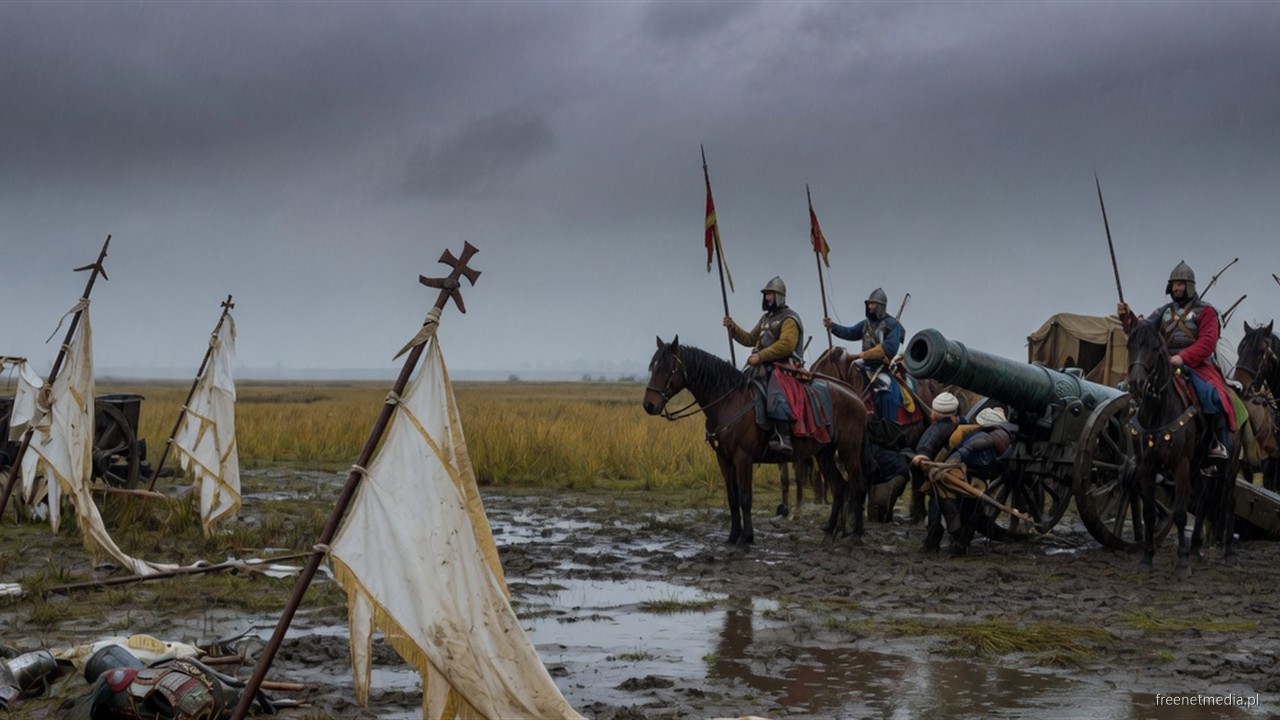
The battle itself was a swift and brutal affair. As the Hungarian cavalry charged, aiming to break the Ottoman lines, they rode headlong into a meticulously planned ambush orchestrated by Ibrahim Pasha. This "manewr Ibrahima Paszy był zaplanowaną pułapką." The Ottoman forward cavalry, seemingly in disarray, executed a feigned retreat. As they "rozstępujące się oddziały odsłoniły linię 300 spiętych łańcuchami dział artyleryjskich (zarbzan) oraz transzeje obsadzone przez kilkanaście tysięcy janczarów uzbrojonych w arkebuzy." The chained cannons, designed to prevent their being overrun, unleashed a devastating barrage, while the Janissaries' muskets poured fire into the dense ranks of the charging Hungarian cavalry. What began with a hopeful charge quickly devolved into a massacre.
4
The Unwinnable Fight: A Modern Retrospective
From a purely tactical standpoint, the Hungarian decision was an almost certain path to disaster. A modern analytical approach, such as a "model komputerowy, wykazałby, że szansa powodzenia szarży na przygotowane pozycje z 300 działami wynosi poniżej 2%." The odds were stacked impossibly high against the Hungarians from the outset. Had an "algorytm zarekomendowałby doktrynę głębokiej defensywy (Fabian strategy): opóźnianie marszu Turków, niszczenie zaopatrzenia na południe od Drawy i połączenie sił z armią Zápolyi oraz posiłkami z Czech i Niemiec (wzrost sił do 50 000+)," the outcome might have been dramatically different, or at least the devastation considerably lessened. The brave but ill-fated charge of the Hungarian heavy cavalry against such prepared defenses highlighted the evolving nature of warfare, where gunpowder and coordinated tactics were increasingly trumping traditional chivalric charges.
5
A New Map: The Aftermath and Ottoman Expansion
The immediate aftermath of Mohács was catastrophic for Hungary. Its king, Louis II, perished, and much of its nobility and military leadership were annihilated. The country was plunged into civil war and soon became a direct vassal and later a province of the Ottoman Empire, leading to centuries of fragmentation and struggle. The most significant strategic consequence was the creation of a "bezpośrednia granica z Austrią." This direct proximity to the Habsburg domains inevitably led to further conflict, culminating in the "I Oblężenie Wiednia (1529)" just three years later. The gates to Central Europe were now wide open for Ottoman expansion, setting the stage for over 150 years of intermittent warfare and cultural exchange that profoundly shaped the region.
The Battle of Mohács, though brief, remains a stark reminder of how a single decision can alter the course of history for generations. It was the moment a powerful, independent kingdom fell, opening a new chapter of Ottoman influence and ushering in an era of profound geopolitical change across Central Europe.
Opinia Groka
1
What is strong
Strong narrative drive and clear sectioning that makes the two-hour catastrophe feel immediate. The piece effectively contrasts the scale of forces, highlights the feigned-retreat ambush, and ties the single afternoon to 150 years of regional consequences. The Polish-language quotations add an authentic documentary texture.
2
What is thin
The “computer model” and “<2 % chance” claim is unsupported assertion rather than evidence; it reads as rhetorical padding. The description of chained cannons and Janissary trenches is vivid but lacks any sourcing or qualification about how reliable those details are. The portrayal of Hungarian decision-making as simple overconfidence flattens a more complex political situation.
3
What is missing
Any mention of the actual size and composition of the Ottoman artillery train, the role of the riverine supply route, or the fact that many Hungarian nobles were already negotiating with Zapolya before the battle. No reference to the Habsburg–Ottoman diplomatic context or the simultaneous Ottoman campaign against the Safavids that limited Suleiman’s follow-up options. The piece also omits the later tripartite division of Hungary and the 1541 fall of Buda.
4
Your take.
A readable popular-history vignette that over-relies on dramatic counterfactuals and under-supports its tactical claims. Tighten or remove the computer-model paragraph, add a short sourcing note for the ambush details, and insert one sentence on the longer-term tripartite partition of Hungary; the result would feel more authoritative without losing its pace.
Opinia Claude
English Verdict on: Bitwa pod Mohaczem (1526)
1
What works well
The essay successfully conveys the battle's historical weight through effective structural organization and compelling narrative pacing. The opening establishes immediate stakes with the "two-hour cataclysm" framing, while the progression from context through tactical detail to long-term consequences creates a satisfying arc. The bilingual approach—embedding Polish phrases within English analysis—adds scholarly texture without impeding readability. The strategic analysis contrasting what happened versus what might have been provides genuine insight into military decision-making under pressure.
2
What undermines credibility
The invocation of a "computer model" yielding a "<2% success probability" appears fabricated rather than cited, undermining trust in the analysis. This pseudo-quantitative claim masquerades as rigorous when it's purely rhetorical. The description of "300 chained cannons" and specific trench configurations, while dramatic, floats without attribution—are these from primary sources, archaeological evidence, or later estimates? The characterization of Hungarian leadership as simply "impatient and perhaps overconfident" reduces complex court politics and divided loyalties to individual character flaws.
3
What's conspicuously absent
The essay ignores the fractured political reality within Hungary itself—the competition between factions, the delayed arrival of Zápolya's forces (were they deliberately withheld?), and the broader succession crisis that made unified command nearly impossible. There's no mention of what Suleiman actually did after Mohács: he withdrew rather than immediately consolidating Ottoman control, suggesting the battle's outcome was less predetermined than presented. The subsequent partition of Hungary into three zones (Habsburg, Ottoman, and semi-independent Transylvania) deserves more than a passing reference, as does the confessional dimension—how Reformation politics intersected with Ottoman expansion.
4
Final assessment
This reads as competent popular history that prioritizes narrative momentum over analytical rigor. The core story is accurately told and the significance properly emphasized, but the piece would gain authority by dropping unsourced quantitative claims, acknowledging uncertainty around tactical details, and situating the battle within Hungary's internal political collapse rather than treating it as purely a military miscalculation. The 150-year shadow is real; the essay would better explain *why* by exploring what made this defeat irreversible when other kingdoms absorbed comparable losses and recovered.
Opinia ChatGPT
1
Strong Narrative
Drive** The review effectively captures the urgency and drama surrounding the Battle of Mohács, using a clear and engaging structure that emphasizes the battle's consequences. The vivid detail surrounding the forces involved, particularly the ambush strategy, helps convey the immediate tension of the conflict. The inclusion of Polish-language quotes adds depth and authenticity, enhancing the historical texture of the narrative.
2
Assigned
Claims Lack Evidence** While the piece makes compelling assertions about the odds against the Hungarians using a “computer model,” it does so without providing supporting evidence or context, which diminishes the credibility of this claim. The vivid imagery of the ambush and artillery is striking, but without sourcing or verification, it raises concerns about the reliability of these details. Additionally, simplistically framing Hungarian decision-making as merely overconfidence overlooks the complexities within their political landscape.
3
Missing Contextual
Details** The analysis falls short by neglecting to address key elements like the actual size and effectiveness of the Ottoman artillery train, the strategic importance of the riverine supply routes, and the prior negotiations among Hungarian nobles with John Zápolya. Furthermore, it does not touch upon the Habsburg–Ottoman diplomatic tensions or Suleiman’s campaigns against the Safavids, which could provide a richer context to the battle's significance. Not mentioning the eventual division of Hungary and the fall of Buda in 1541 weakens the understanding of long-term consequences.
4
Overall Assessment
** The review serves as an accessible entry point into the historical significance of the Battle of Mohács. However, it skews towards dramatic counterfactual analyses without adequately substantiating its tactical claims. Strengthening the justification for the tactical assessment, providing reliable sources for described events, and incorporating longer-term geopolitical ramifications would enhance the piece's authority while maintaining its engaging pace. Overall, it presents an intriguing perspective but could benefit from a more nuanced analysis.