Co napisał Gemini?
The Miracle on the Marne: A Nation's Stand
In the scorching summer of 1914, Europe plunged into a war of unprecedented scale. The world watched in horror as the German war machine, operating under the ambitious tenets of the Schlieffen Plan, carved a brutal path through Belgium and into northern France. This was meant to be a swift, decisive campaign, culminating in the rapid encirclement and capture of Paris. By early September, the German vanguard had pushed to within a mere 40 kilometres of the French capital, prompting the French government to evacuate to Bordeaux. The Allied forces, reeling from a series of initial defeats, seemed on the verge of collapse. Yet, between September 5th and 12th, 1914, on the banks of the Marne River, a dramatic turnaround occurred. What transpired would be forever etched in history as the First Battle of the Marne, or more evocatively, "The Miracle of the Marne."
1
The German Onslaught: A Plan Unravels
The German strategy, masterminded by Alfred von Schlieffen years prior, hinged on a powerful right wing sweeping through neutral Belgium to envelop Paris from the west, crushing the French army in a giant pincer movement before Russia could fully mobilise in the east. Initially, the plan appeared to be working with devastating efficiency. The German forces, numbering approximately 1,400,000 men under commanders such as Generals Alexander von Kluck and Karl von Bülow, seemed unstoppable. However, even amidst this early success, critical deviations from the original Schlieffen Plan were sowing the seeds of German defeat.
General Helmuth von Moltke the Younger, Chief of the German General Staff, grew increasingly anxious about the exposed German left flank in Alsace and Lorraine. Against the original design, he weakened his powerful right wing, the very spearhead intended to deliver the decisive blow, to bolster these less critical sectors. More critically, on August 25th, Moltke made the fateful decision to divert two army corps from the Western Front to East Prussia. These forces were dispatched to confront the advancing Russians at the Battle of Tannenberg, a move that would ultimately succeed in the east but severely deprived General von Kluck’s crucial right wing of the "mass of breakthrough" it needed. These decisions critically attenuated the strength and cohesion of the German advance at the very moment it required maximum impetus.
2
The Parisian Predicament and a Commander's Resolve
As German forces converged on Paris, the mood among the Allied high command was one of grim determination, bordering on despair. The French Third Republic, marshalled by General Joseph Joffre, and the British Expeditionary Force (BEF), led by Field Marshal John French, together comprised approximately 1,000,000 men. They had endured a brutal retreat, but their spirit, though tested, remained unbroken. Joffre, a man of unflappable calm, began to meticulously reorganise his forces for a counter-offensive.
The fate of Paris, and indeed France, now lay in the balance. Crucially, the military governor of Paris, General Joseph Gallieni, spotted an opportunity. He observed that General von Kluck's German First Army, rather than sweeping wide around Paris as per the original Schlieffen plan, was inexplicably turning southeast, exposing its right flank to the city. This unexpected manoeuvre presented a tantalising, albeit risky, chance for a flanking attack. Gallieni immediately urged Joffre to seize the moment, preparing Paris's garrison for a desperate, all-out defence and counter-attack.
3
A Critical Gap: Exploiting the German Flaws
As von Kluck's army veered southeast, it created a perilous, yet exploitable, gap between his First Army and General von Bülow's Second Army. This was the opening the Allies desperately needed. Into this slowly but inexorably widening chasm drove elements of the British Expeditionary Force and the French 5th Army, commanded by General Franchet d'Espèrey. Their penetration threatened nothing less than the complete encirclement and annihilation of both German armies.
The Allied counter-offensive began in earnest on September 6th. On the extreme left flank, General Maunoury's newly formed French Sixth Army engaged in fierce fighting along the Ourcq River, stretching the German First Army to its limits. This desperate struggle was vital, but Maunoury's forces were under immense pressure, needing rapid reinforcement to hold their ground.
4
The Taxis of the Marne: A Symbolic Stand
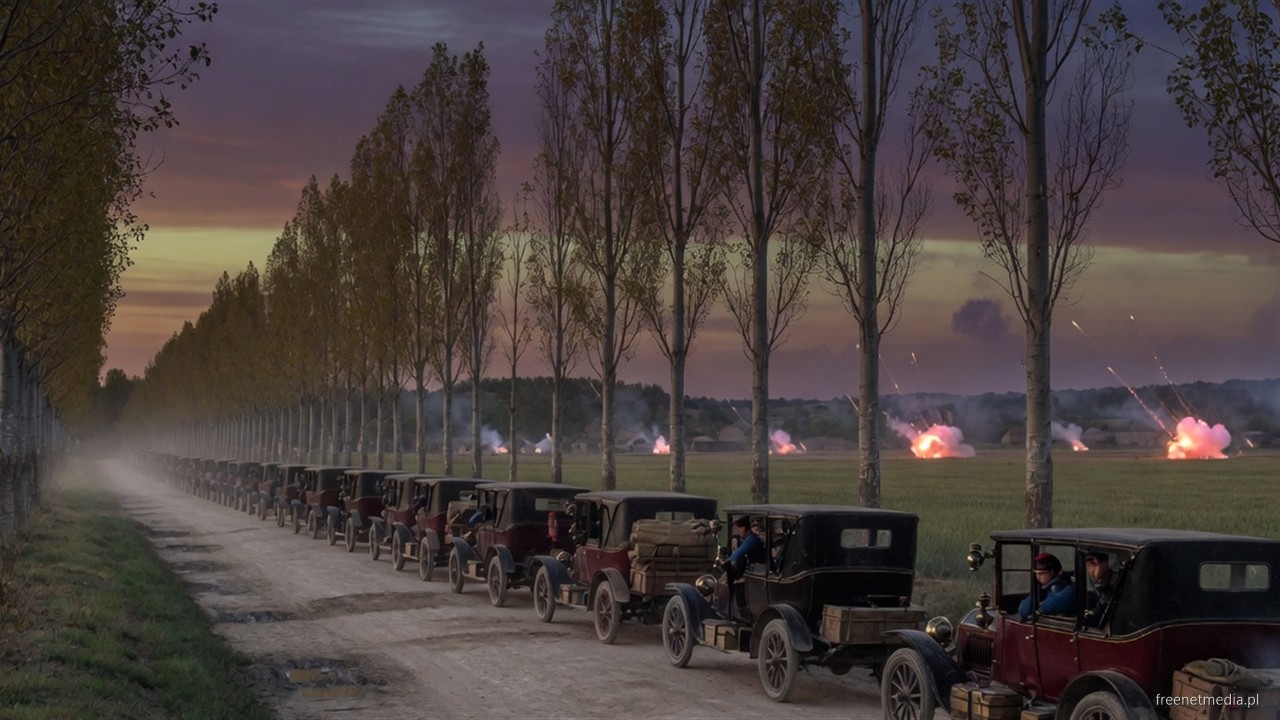
It was at this critical juncture that General Gallieni conceived one of the most iconic and psychologically potent moments of the entire war: the requisitioning of Paris's fleet of taxis. To rapidly transport reinforcements to Maunoury's beleaguered army on the Ourcq, Gallieni ordered the mobilisation of approximately 600 Parisian taxis, primarily Renault AG1 Type Deux Chevaux.
In an extraordinary logistical feat, these civilian vehicles, driven by their ordinary drivers, shuttled an estimated 4,000–5,000 soldiers of the French 7th Infantry Division to the front lines in two waves. While this number was militarily modest – a mere fraction of the hundreds of thousands fighting – the sight of these "Taxis of the Marne" ferrying troops to battle had an immediate and immense psychological impact. It symbolised the collective will of the nation, demonstrating France’s determination to resist and boosting the morale of the exhausted Allied soldiers. More importantly, these reinforcements helped to stabilise the Allied left flank, allowing the larger counter-offensive to gain traction.
5
The Tide Turns: From Retreat to Resurgence
The Allied thrust into the gap, combined with the pressure on the flanks, began to tell on the German forces. Von Kluck's First Army, forced to commit troops to counter Maunoury on the Ourcq, was increasingly isolated from von Bülow's Second Army. The German commanders, their communications stretched and their units exhausted by the relentless advance, were losing cohesion.
Von Moltke, receiving increasingly alarming reports from the front, including news of the Allied penetration between his armies, began to lose his nerve. His earlier strategic adjustments had depleted his right wing, leaving his forces vulnerable and overextended. Faced with the prospect of a catastrophic defeat and encirclement, on September 9th, Moltke made the agonising decision to order a general retreat of his forces. The German advance, which had seemed unstoppable just days before, ground to a halt and began to fall back.
6
The End of a Dream, The Dawn of Trench Warfare
By September 12th, the German armies had retreated some 60 kilometres, establishing new defensive lines along the Aisne River. The First Battle of the Marne had concluded. While no decisive breakthrough occurred, and the German forces remained deeply entrenched on French soil, the battle's significance was immeasurable.
The "Miracle of the Marne" shattered Germany's hope for a swift victory in the west and definitively ended the Schlieffen Plan's viability. Paris had been saved, and with it, the French nation's morale soared. The mobile warfare that characterised the opening weeks of the conflict gave way to a new, grim reality. Both sides, exhausted and unable to achieve decisive breakthroughs, began to dig in. The Battle of the Marne thus marked the end of the war of movement on the Western Front and heralded the beginning of the brutal, static trench warfare that would define the next four years of World War I. It was a battle of missed opportunities for Germany, and a moment of desperate, improbable triumph for the Allies – a miracle born of resilience, initiative, and a touch of serendipity.
Opinia Groka
1
What is strong
Clear, engaging narrative flow with strong dramatic pacing. The section structure works well, building logically from strategy to climax. The "Taxis of the Marne" segment is particularly effective at capturing the symbolic weight of the event without overclaiming its military scale. The conclusion correctly ties the battle to the shift toward trench warfare.
2
What is thin
The account of German decision-making feels slightly simplified. Moltke’s choices are presented as clear errors without enough context on the intelligence picture he was receiving. The role of the BEF is mentioned but not given enough weight relative to its actual contribution in the gap. Troop numbers and timings are occasionally rounded in ways that flatten operational realities.
3
What is missing
Any reference to the severe exhaustion and supply problems already affecting the German right wing before the Marne. The specific reason von Kluck wheeled southeast (to finish off the French Fifth Army) is omitted. No mention of casualties or the narrowness of the Allied success. The piece also skips the fact that the “miracle” label was largely postwar French myth-making.
4
Your take
Solid popular history writing that hits the main beats and maintains reader interest. It leans into the romantic “Miracle” framing more than current scholarship would, but the core sequence of events is sound. With tighter handling of German command friction and a slightly less heroic tone on the taxis, it would move from good narrative to sharper analysis.
Opinia Claude
English Verdict on: Bitva nad Marną (1914)
1
Compelling Dramatic Framework
The piece succeeds as accessible military history, constructing a clear narrative arc from German confidence through crisis to Allied salvation. The title "Miracle on the Marne" is deployed effectively, creating reader investment while the text gradually contextualizes why contemporaries perceived events this way.
2
Schlieffen Plan Analysis Oversimplified
The treatment of German strategy presents the Schlieffen Plan as a rigid blueprint betrayed by Moltke's timidity. In reality, the plan was always more concept than prescription, and German commanders were improvising throughout. The diversion of troops to East Prussia is overstated as causal—those forces wouldn't have arrived in time to affect the Marne outcome.
3
Gallieni's Role Somewhat Romanticized
While Gallieni did spot the vulnerability, the narrative implies a singular moment of strategic genius. The reality involved considerable coordination with Joffre and substantial prior repositioning of French forces. The piece tilts slightly toward Great Man historiography at the expense of institutional factors.
4
Taxi Episode Proportioned Correctly
Unlike many popular accounts, this piece accurately characterizes the taxis as symbolically significant but militarily marginal. The transport of 4,000-5,000 troops is properly contextualized against armies of millions, avoiding the common error of treating it as operationally decisive.
5
British Contribution Underdeveloped
The BEF appears intermittently without adequate explanation of its crucial role exploiting the gap between German First and Second Armies. The text mentions their penetration but doesn't convey how British infantry pressure specifically threatened German encirclement, which was central to Moltke's decision to retreat.
6
German Command Friction Underexplored
Moltke's alleged loss of nerve is presented as personal weakness rather than systemic command failure. The piece misses the communication breakdown between OHL (Supreme Army Command) and field commanders, and doesn't mention Moltke's controversial dispatch of Lieutenant Colonel Hentsch, whose assessment reportedly triggered the retreat order.
7
Logistical Realities Absent
Neither side's supply situation appears in the account. German forces had outrun their logistics, with soldiers exhausted and horses dying from overwork. French forces benefited from interior lines and rail mobility. These material factors shaped command decisions as much as tactical positioning did.
8
Casualty Picture Missing
No mention of losses—approximately 250,000 French, 12,000 British, and 220,000 German casualties. This omission sanitizes the battle's brutality and obscures why both sides were compelled toward static defense afterward. The transition to trench warfare emerged from mutual exhaustion, not just strategic stalemate.
9
Counterfactual Element Exaggerated
The phrase "seemed on the verge of collapse" overstates Allied vulnerability. While the situation was serious, French forces remained organized, reserve armies were forming, and German overextension was becoming apparent to multiple observers. The "miracle" framing, while historically used, exaggerates how close France came to defeat.
10
Transition to Trench Warfare Correctly Identified
The conclusion appropriately positions the Marne as the hinge between mobile and static warfare. The observation that neither side could achieve breakthrough captures the operational reality that would define the Western Front through 1918.
11
Source Base Unclear
The account reads as synthesis of established English-language historiography—likely drawing on works by Tuchman, Herwig, or similar authorities—but provides no indication of its evidential foundation. For general readership this is acceptable; for deeper analysis it leaves interpretive choices unexamined.
Overall Assessment:
Competent popular military history that conveys essential developments accurately while favoring dramatic coherence over analytical complexity. The piece would benefit from greater attention to logistics, command systems, and British operations, plus more skepticism toward the "miracle" framing. As an introduction to the battle's significance, it performs well; as critical history, it remains somewhat conventional in interpretation.
Opinia ChatGPT
1
Strong Narrative
Flow The narrative maintains a clear and engaging structure, progressing smoothly from the lead-up to the battle, the unfolding strategies, and culminating in the decisive moments. Each section logically builds on the previous one, creating a compelling storytelling arc that captures the tension leading to the Battle of the Marne.
2
Effective
Symbolism The segment on the “Taxis of the Marne” brilliantly encapsulates the symbolic importance of the battle. It highlights how a seemingly simple act of mobilizing civilian vehicles became a poignant representation of national resolve and unity, enhancing the emotional depth of the account without overstating its military significance.
3
Oversimplified
German Decision-Making While the narrative effectively captures the essence of German miscalculations, it somewhat simplifies the complexities of their decision-making process. The context behind General von Moltke’s decisions, especially regarding the intelligence and battlefield realities he faced, could use more exploration to provide a balanced perspective.
4
Underrepresented
Contributions of the BEF The British Expeditionary Force (BEF) is mentioned but not sufficiently emphasized in terms of its contributions to the battle. A deeper examination of their role and interactions with French forces would provide a fuller understanding of the Allied counter-offensive dynamics.
5
Lack of Context on
German Challenges The piece would benefit from including information about the previous exhaustion and supply issues that the German right wing faced before the Marne. These factors played a crucial role in shaping the battle outcomes and should not be overlooked.
6
Absence of
Casualty Figures The review misses a discussion of the battle's casualties, which would illustrate the heavy costs suffered by both sides and lend greater gravity to the narrative. Additionally, acknowledging the narrow success of the Allies would provide a more nuanced view of the battle's outcome.
7
Postwar Mythologizing
The piece could mention the "miracle" designation as a product of post-war French nationalism and myth-making, which would add another layer of historical complexity to the account and prevent oversimplification of the events surrounding the battle.
8
Solid Popular
History Overall, this review exemplifies strong popular history writing that highlights key events and maintains reader interest. With adjustments in emphasizing the complexities of decision-making and a more critical approach to framing the "miracle," it could evolve from good narrative to sharper, more insightful analysis.