Co napisał Gemini?
The Winged Saviors: Vienna's Deliverance and the Dawn of a New Europe (1683)
In the annals of military history, few battles carry the weight and symbolic significance of the Relief of Vienna, known in Polish as Odsiecz Wiedeńska. Fought on September 12, 1683, it was a clash that dramatically altered the geopolitical landscape of Europe, halting the seemingly unstoppable tide of Ottoman expansion and securing the heart of the Holy Roman Empire. More than just a victory, it was a moment of unprecedented collaboration, strategic brilliance, and sheer bravery, forever etched into the collective memory of the continent.
1
The Crescent at the Gates
By the summer of 1683, the Ottoman Empire, under the ambitious leadership of Grand Vizier Kara Mustafa Pasha, had set its sights on Vienna, the imperial capital of the Habsburgs. It was not merely a conquest but a declared holy war, aiming to extend the dominion of the Sultan deep into Central Europe. From July 1683, a formidable Ottoman army, numbering over 130,000 seasoned warriors, laid siege to the city.
Inside Vienna’s ancient walls, the defenders, led by the stoic Count Ernst Rüdiger von Starhemberg, braced for the inevitable. The situation grew increasingly desperate with each passing week. By September, after two months of relentless bombardment and sapping operations, the city was on the verge of collapse. Ottoman engineers, masters of siege warfare, had successfully detonated powerful gunpowder mines, tearing apart key bastions like Burg and Löwel, creating breaches that threatened to open the city to a final, devastating assault. Famine and disease ravaged the populace, and hope dwindled with every fallen brick. Europe held its breath, acutely aware that Vienna's fall could pave the way for a deeper Ottoman thrust into the heart of the continent.
2
A King's Gambit: The Race to Vienna
As Vienna teetered on the brink, a glimmer of hope emerged from the north: Jan III Sobieski, the King of Poland. A brilliant military strategist and a deeply religious man, Sobieski recognized the existential threat posed by the Ottomans not just to Austria, but to all of Christian Europe. He forged an alliance with Emperor Leopold I, agreeing to lead a Polish-Lithuanian relief force, despite his own kingdom facing internal and external pressures.
What followed was a logistical majstersztyk, a testament to Sobieski’s resolve and the endurance of his men. The Polish crown forces embarked on a grueling march, covering over 350 kilometers (approximately 217 miles) in less than two weeks. This rapid deployment, through difficult terrain and often torrential rain, was crucial. They crossed the Danube via a pontoon bridge near Tulln, a vital strategic move, and successfully linked up with the gathered Austrian and German forces. The combined relief army, a diverse coalition of nations and banners, took up positions on the forested slopes of the Kahlenberg and Leopoldsberg hills, overlooking the besieged city and the sprawling Ottoman encampment. The stage was set for a confrontation of epic proportions.
3
The Winged Thunder
The morning of September 12, 1683, dawned with a heavy mist clinging to the hills, obscuring the movements of the allied forces. As the mist began to lift, the Ottoman army below suddenly found itself facing a vast, unexpected host arrayed on the heights. The battle commenced early, with intense fighting for control of the hills. Sobieski, taking the overall command, meticulously planned his assault. The allied infantry and smaller cavalry units engaged the Ottoman flanks, drawing their attention and weakening their defenses.
By late afternoon, after hours of fierce fighting and with the Ottoman lines stretched thin, Sobieski judged the moment was ripe for a decisive strike. From his vantage point on the Kahlenberg, he could see the Grand Vizier’s richly adorned tent, a clear target at the heart of the enemy camp. The Polish King, known for his audacious tactics, decided to unleash his most potent weapon.
4
The World's Largest Cavalry Charge
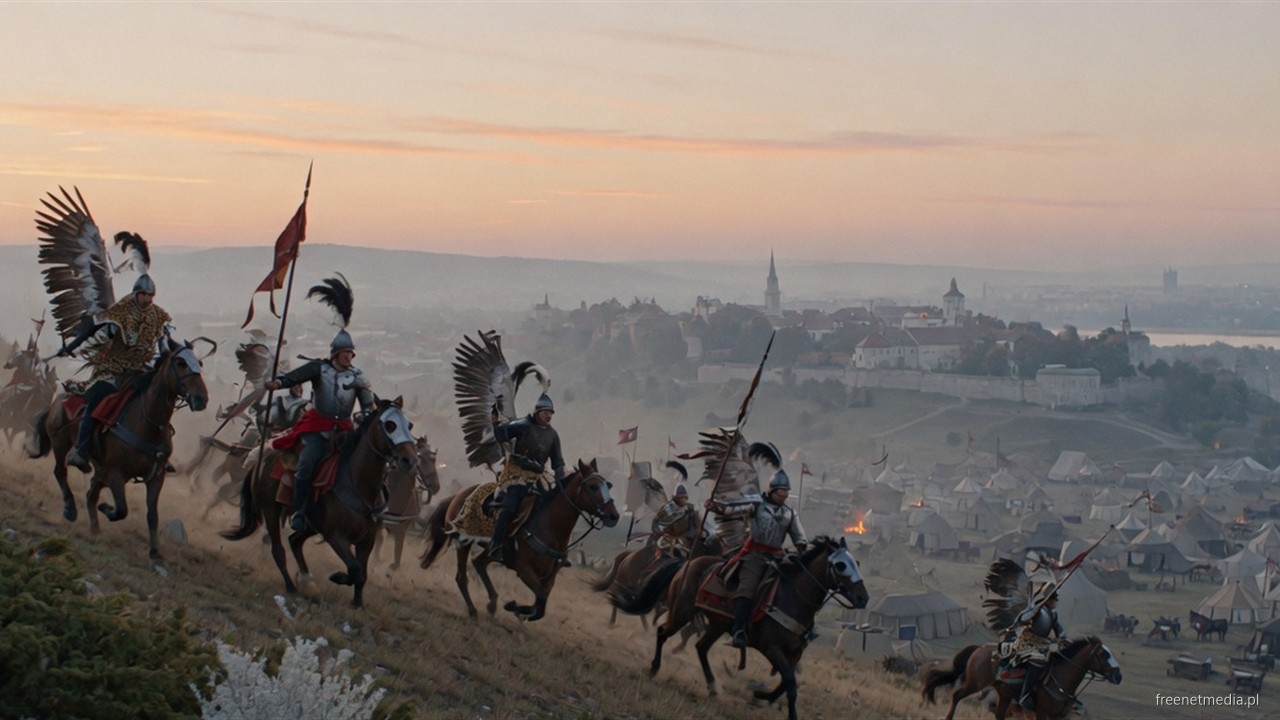
At precisely 6:00 PM, a roar erupted from the Kahlenberg. Down the slopes thundered the largest cavalry charge in the history of warfare. More than 18,000 riders, a thunderous avalanche of steel and horseflesh, surged forward. At the vanguard were the legendary Polish Winged Hussars – approximately 3,000 of these elite shock troopers, instantly recognizable by their towering feathered wings and devastating lances. King Sobieski himself led this fearsome charge, placing himself at the head of his most formidable warriors.
The impact was cataclysmic. The colossal cavalry force struck directly into the heart of the Ottoman camp, targeting the Grand Vizier's tents and the center of the Turkish positions. The sheer momentum, speed, and disciplined ferocity of the charge were overwhelming. In less than 30 minutes, the vast and once-feared Ottoman defense buckled and then shattered. Kara Mustafa's entire army, caught completely by surprise and demoralized by the direct assault on their command, dissolved into a panicked rout, fleeing in disarray and abandoning their siege equipment, supplies, and treasures. Vienna was free.
5
The Aftermath: A Turning Tide
The immediate aftermath was one of stunned relief and immense spoils. The victorious allied forces liberated Vienna, ending the two-month siege and saving the city from certain destruction. The Ottoman camp, left behind in the hasty retreat, offered a treasure trove of gold, jewels, weapons, and provisions, along with countless tents, including Kara Mustafa's lavish personal quarters. Sobieski reportedly sent the captured banner of the Prophet to the Pope, a potent symbol of the victory.
However, the consequences extended far beyond the battlefield. While skirmishes and campaigns against the Ottomans would continue for years, the Battle of Vienna definitively marked the end of their expansionist ambitions into Central Europe. It was a turning point, a psychological and military defeat from which the Ottoman Empire would struggle to recover.
6
The Echoes of 1683: A New Dawn for Europe
The historical impact of 1683 cannot be overstated. The Relief of Vienna arrested the Ottoman threat that had loomed over Europe for centuries. It galvanized a sense of shared European identity, uniting disparate Christian states against a common foe. The victory allowed the Habsburgs to consolidate their power and eventually embark on a series of successful counter-offensives that would push the Ottomans out of Hungary and other territories.
For Poland, it was the zenith of its military power and prestige, solidifying King Sobieski's legacy as a defender of Christendom. Though Poland's golden age would soon fade, the memory of the Winged Hussars' thundering charge and the miraculous deliverance of Vienna would endure, a powerful testament to courage, strategic genius, and a crucial moment when the fate of a continent hung in the balance. The Battle of Vienna was not merely a military triumph; it was the dawn of a new era, securing the future trajectory of European civilization.
Opinia Groka
1
What is strong
Vivid, cinematic prose that builds tension effectively across sections. The narrative arc from siege desperation to the climactic charge is well-paced and engaging. Strong use of sensory detail in the battle description and a clear thematic focus on European unity against Ottoman expansion.
2
What is thin
Several claims are asserted without qualification or evidence, such as the charge being “the largest in history,” the precise 18,000-rider figure, and the speed of the Polish march. The Ottoman perspective and internal coalition frictions receive almost no space, leaving the account one-sided. Occasional anachronistic or overly dramatic phrasing (“majstersztyk,” “thunderous avalanche”) weakens precision.
3
What is missing
Acknowledgment of the multinational command structure (Charles of Lorraine, John George III of Saxony, etc.) and their contributions to the victory. Any mention of the subsequent Holy League campaigns that actually rolled back Ottoman control in Hungary. A brief note on source reliability or historiographical debate would also help ground the more spectacular assertions.
4
Your take
The piece succeeds as popular military history aimed at a general audience; it captures drama and stakes without becoming dry. However, its heavy Polish-centric lens and occasional factual looseness make it better suited for inspirational reading than as a balanced reference. Tightening numbers, adding coalition context, and trimming a few hyperbolic turns would raise its credibility without sacrificing readability.
Opinia Claude
English verdict on: Odsiecz Wiedeńska (1683)
1
What succeeds
The narrative achieves genuine drama through careful pacing and structural choices. Opening with Vienna on the brink of collapse establishes immediate stakes, while the progression through Sobieski's march and the climactic charge creates satisfying momentum. The writing balances accessibility with substance—technical details like the Danube crossing at Tulln and the targeting of specific bastions ground the drama in tactical reality. The framing of 1683 as a civilizational turning point, rather than merely a battle, gives the piece appropriate historical weight.
2
What falters
The account suffers from uncritical maximalism in several claims. "The largest cavalry charge in the history of warfare" requires substantial qualification—numerical supremacy depends heavily on how one counts ancient and medieval engagements poorly documented by comparison. The "less than 30 minutes" collapse of Ottoman resistance oversimplifies a more complex, hours-long battle. The piece occasionally slides into hagiography, particularly around Sobieski, without acknowledging his controversial decision-making or the significant role of other commanders. The phrase "holy war" applied to Ottoman aims imports later terminology anachronistically.
3
What is absent
The multinational character of the relief force receives inadequate treatment. Charles of Lorraine commanded the Imperial forces and played a crucial coordinating role; John George III of Saxony brought significant German contingents. The article mentions a "diverse coalition" but never explores the tensions, logistical complexity, or competing command interests that nearly derailed the operation. Ottoman internal politics—Kara Mustafa's fraught relationship with the Sultan, his strategic errors, the Janissaries' declining effectiveness—remain unexplored, flattening the Ottomans into a monolithic adversary. The subsequent Great Turkish War (1683-1699) that actually secured the gains of Vienna is mentioned only in passing.
4
Overall Assessment
This functions effectively as inspirational popular history with genuine literary merit, but its Polish-centric perspective and occasional factual overreach limit its usefulness as balanced reference material. The core narrative is sound and the significance properly emphasized, yet the piece would gain authority by moderating superlatives, acknowledging coalition complexity, and providing at least minimal Ottoman perspective. For a general audience seeking an engaging introduction to the battle, it succeeds admirably; for readers wanting nuanced military history, it requires supplementation.
Opinia ChatGPT
1
Strengths of the
Review** The review effectively captures the grandeur and intensity of the Relief of Vienna through evocative prose. The use of vivid descriptions immerses the reader, bringing to life the dramatic shift from siege to triumphant relief. The narrative structure is engaging, successfully charting the escalation of tension leading up to the pivotal cavalry charge. Additionally, the thematic emphasis on European unity provides a strong historical context.
2
Areas of
Weakness** While the dramatic elements are compelling, there are several claims within the review that lack sufficient support or citation, such as the assertion of the charge being the “largest in history” and the specific number of 18,000 riders. The focus on the Polish perspective leaves other significant contributors, especially commanders from various nations, underrepresented, leading to a somewhat skewed narrative.
3
Missing Perspectives**
The review would benefit from acknowledging the broader coalition of forces united against the Ottomans, including figures like Charles of Lorraine and John George III of Saxony. Additionally, it lacks discussion of the subsequent campaigns by the Holy League that ultimately helped to push back Ottoman influence in Central Europe. Including a brief mention of the historiographical debates regarding these events would add depth and credibility.
4
Personal
Assessment** The review excels in storytelling, making it accessible and appealing to a wide audience interested in military history. However, it tends to skew towards a glorified Polish perspective and employs occasional exaggerations which may detract from its historical integrity. Balancing this account with a more comprehensive acknowledgment of the coalitions involved and addressing some overstatements would enrich the narrative and enhance its reliability as a historical resource. Overall, it serves well as inspirational literature but should be read with a critical eye for accuracy.