Co napisał Gemini?
The Azure Crucible: Lepanto, 1571
The year 1571 was a crucible for Europe. For decades, the Ottoman Empire had been a relentless tide, its armies sweeping across the Balkans, its formidable fleet asserting dominance over the Mediterranean. Christian Europe, fractured by internal strife and religious divisions, watched with growing alarm as the Ottoman crescent drew ever closer to its shores. The capture of Cyprus, a Venetian stronghold, in August 1571, served as the final, chilling catalyst, igniting a desperate coalition – the Holy League – to confront the seemingly unstoppable power of the Sultan.
What followed, just a few months later, was a naval engagement of staggering scale and ferocity, an event that would echo through history as one of its most pivotal battles. It was a clash of empires, ideologies, and faiths, fought on the shimmering expanse of the Ionian Sea, off the Greek coast: the Battle of Lepanto.
1
A Gathering Storm: The Holy League Assembles
The formation of the Holy League was a diplomatic triumph born of necessity. Pope Pius V, a fervent advocate for a united Christian front, tirelessly worked to forge an alliance between the two dominant Catholic maritime powers: Habsburg Spain, under King Philip II, and the Republic of Venice. Reluctant allies, their historical rivalry and competing interests often outweighed their shared faith. Yet, the existential threat posed by the Ottomans, particularly to Venice's lucrative trading empire and Spain's Mediterranean territories, proved too great to ignore. Smaller contingents from Genoa, Savoy, the Knights of Malta, and various Italian states swelled their ranks.
Command of this disparate, multi-national fleet was entrusted to Don Juan of Austria, King Philip II's charismatic and ambitious half-brother. Though only 24 years old, Don Juan possessed both tactical acumen and the ability to inspire loyalty across national lines, a crucial attribute for leading such a diverse force. His counterpart was Müezzinzade Ali Pasha, a veteran Ottoman admiral, leading a fleet honed by decades of victory.
2
The Opposing Fleets: Galleys and Galleasses
On October 7, 1571, the two colossal fleets sighted each other in the Gulf of Patras, near the mouth of the Corinthian Gulf. The Ottoman fleet, numbering over 250 galleys and smaller vessels, formed a formidable crescent, aiming to envelop the Christian ships. Their crews, seasoned by countless campaigns, were confident in their numerical superiority and the perceived invincibility of the Sultan's navy.
The Holy League's fleet, though slightly smaller in total number of ships, compensated with some revolutionary additions and a bold tactical disposition. Don Juan of Austria had at his disposal approximately 200 galleys, alongside six colossal Venetian galleasses – heavily armed, oar-and-sail warships, essentially floating fortresses bristling with artillery.
3
Don Juan's Innovation: Breaking the Crescent
Don Juan’s strategy was audacious and ultimately decisive. Recognizing the raw power of the Venetian galleasses, he positioned these giants in pairs at the forefront of each wing and the center of his battle line, approximately 800–1000 meters ahead of the main galley formations. This was a radical departure from traditional galley warfare.
As the Ottoman fleet advanced, confident in their crescent formation designed to outflank and overwhelm, they sailed directly into a storm of cannon fire. The broadsides from these Venetian behemoths were devastating. Their heavy artillery, far exceeding the firepower of the lighter Ottoman galleys, began to tear through the enemy ranks. Several dozen Ottoman galleys were sunk or severely damaged, their meticulously planned crescent formation shattered and disorganized even before the main battle lines could properly engage in hand-to-hand combat. This initial, brutal cannonade was a psychological as well as a physical blow, sowing confusion and disarray among the Ottoman crews.
4
The Fury of the Engagement
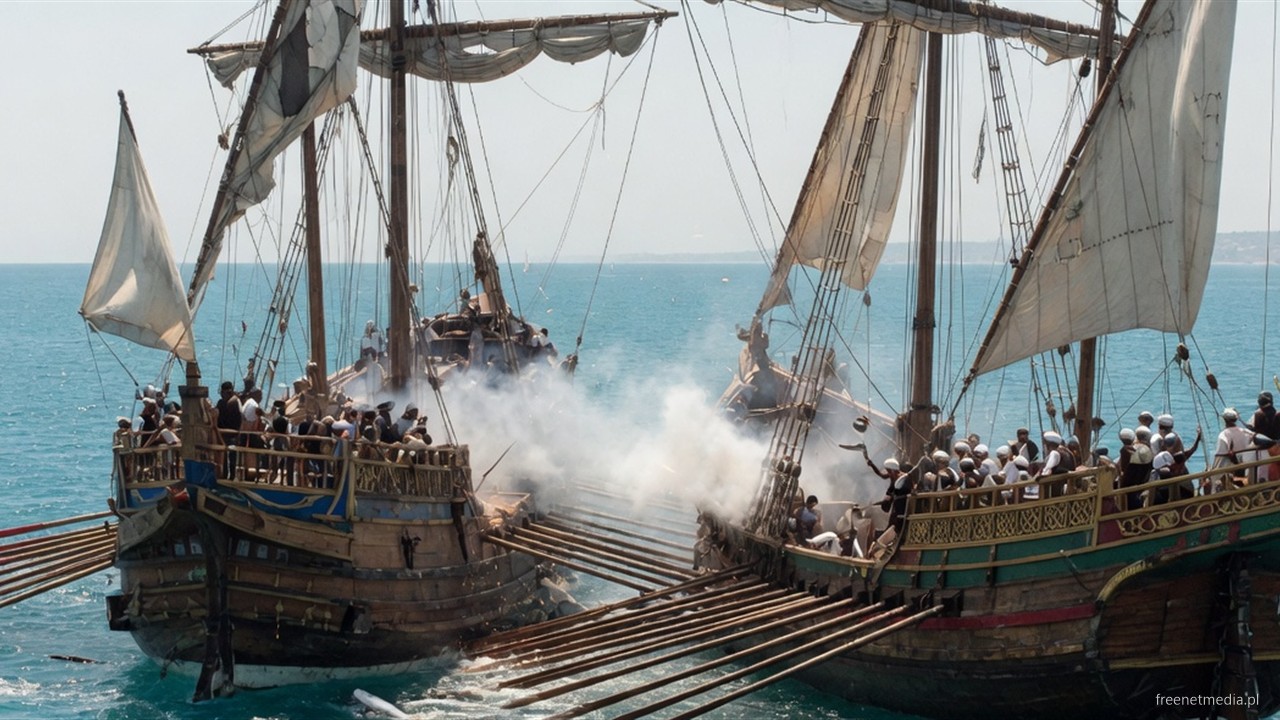
With the Ottoman formation broken, the two fleets crashed into each other in a chaotic, bloody melee. Galleys grappled, their oars snapping, their decks swarming with soldiers. Lepanto was a battle of steel and muscle, a naval engagement that quickly devolved into a land battle at sea. Thousands of men, from Spanish tercios and Venetian marines to Ottoman Janissaries and corsairs, fought with desperate ferocity. Archers rained down arrows, arquebuses cracked, and swords clashed as boarding parties surged across gangplanks.
The fighting around the opposing flagships was particularly fierce. Don Juan’s Real, adorned with a golden cross, locked horns with Ali Pasha’s Sultana. After hours of relentless combat, Ali Pasha was killed, his head hoisted on a pike, a devastating blow to Ottoman morale. The battle raged for four long hours, a maelstrom of smoke, fire, and blood.
5
A Decisive Victory, Heavy Losses
By late afternoon, the tide had unequivocally turned. The Holy League had achieved a stunning, comprehensive victory. The scale of the Ottoman defeat was catastrophic: over 200 Ottoman ships were lost, with 130 captured and the remainder sunk. The human cost was even more staggering, with an estimated 25,000–30,000 Ottoman soldiers and sailors killed, drowned, or captured. In a moment of profound liberation, approximately 12,000 Christian galley slaves, forced to row the Ottoman vessels, were freed from their chains.
The victory, however, came at a heavy price for the Holy League as well, with around 7,500–10,000 casualties and dozens of galleys damaged or destroyed.
6
The Unfolding Legacy: Status Quo and Enduring Pressure
The immediate aftermath of Lepanto was one of euphoria in Christian Europe. It was hailed as a miracle, a divine intervention that had saved Christendom from the perceived Ottoman menace. The battle unequivocally checked Ottoman naval supremacy in the western Mediterranean, delivering a profound psychological blow to an empire that had seemed invincible. It proved that the seemingly unstoppable Ottoman war machine could, indeed, be defeated.
However, the longer-term strategic impact is often debated. While a monumental victory, Lepanto did not fundamentally alter the geopolitical status quo in the Mediterranean or halt Ottoman expansion entirely. The Ottoman Empire, a vast and resilient entity, possessed immense resources. Within a few years, they had largely rebuilt their fleet, demonstrating their remarkable capacity for recovery. Though their direct naval dominance in the western Mediterranean was curtailed for a time, Ottoman pressure on other fronts continued. Indeed, subsequent years saw a maintenance of the *status quo* and even further Ottoman expansionist aspirations into areas like the Balearics and parts of Italy, albeit not with the same immediate naval threat as posed by the pre-Lepanto fleet. The threat was mitigated, not eliminated.
Nevertheless, Lepanto remains a landmark event. It stands as a testament to strategic innovation, the power of combined arms, and the enduring human capacity for desperate resistance against overwhelming odds. It was a day when the balance of power, however temporarily, swung away from the crescent and towards the cross, forever cementing its place in the annals of naval history.
Opinia Groka
1
What is strong
Clear, engaging narrative voice with strong dramatic pacing. The piece effectively highlights the tactical innovation of the galleasses and Don Juan’s positioning as the decisive factor. The structure is logical and easy to follow, moving from background through battle to legacy without losing momentum. The acknowledgment that Lepanto was a major psychological victory but did not end Ottoman power shows a balanced perspective.
2
What is thin
The description of the melee phase is quite generalized; it does not convey how the fighting actually unfolded across the three main divisions (left, center, right). The Ottoman perspective remains thin—Ali Pasha is mentioned, but there is little on Ottoman tactics, command structure, or why their crescent formation failed once disrupted. Numbers for ships and casualties are given as ranges without noting that historians still debate the exact figures.
3
What is missing -
Any mention of the Venetian intelligence and shipbuilding effort that produced the galleasses so quickly. - The role of the reserve squadron (the “rear guard”) under Don Juan and its impact on the battle. - The fact that the Holy League dissolved almost immediately after the victory and could not exploit it strategically. - The continued Ottoman ability to project power in the eastern Mediterranean and the rapid rebuilding of their fleet in 1572. - A brief note on the battle’s place in the shift from oared galleys toward sail-powered warships.
4
Your take
This is a solid, readable popular account that gets the essentials right and correctly stresses the psychological effect of the victory. It would be stronger with tighter tactical detail in the middle phase and a slightly sharper distinction between the immediate naval result and the longer-term strategic stalemate. Minor tightening of casualty/ship figures and one additional paragraph on the post-battle political reality would lift it from good to excellent.
Opinia Claude
English verdict on: Bitwa pod Lepanto (1571)
1
What is strong
The narrative successfully captures the dramatic scale and significance of Lepanto through vivid, accessible prose that transforms military history into compelling storytelling. The opening metaphor of 1571 as a "crucible" immediately establishes stakes and tension. The treatment of the galleasses as game-changing weapons is particularly well-executed, showing how technological innovation disrupted traditional naval tactics. The piece correctly identifies the battle's psychological impact as perhaps more significant than its immediate strategic consequences, demonstrating historical nuance. The section on the Holy League's formation effectively conveys the difficulty of uniting fractured Christian powers against a common threat.
2
What is thin
The Ottoman perspective receives inadequate attention—Ali Pasha appears mainly to die dramatically rather than as a commander with his own strategic considerations. The actual mechanics of galley warfare remain vague; readers learn that ships "grappled" and men "fought with desperate ferocity" but gain little understanding of boarding tactics, artillery deployment on galleys, or the coordination required in such engagements. The casualty figures are presented without acknowledging their contested nature in historical scholarship. The discussion of the battle's aftermath oversimplifies complex geopolitical realities into a simple "psychological victory without strategic follow-through" narrative.
3
What is missing
The piece omits the critical role of Uluch Ali, the Ottoman left-wing commander who executed a successful tactical withdrawal, saving a substantial portion of the fleet and preventing total annihilation. There's no mention of Miguel de Cervantes, who fought at Lepanto and lost use of his left hand—a detail that humanizes the battle and connects it to cultural history. The complex reasons why Venice quickly made separate peace with the Ottomans, betraying the Holy League, would illuminate why victory wasn't exploited. The technological context—that this was essentially the last great galley battle and marked a transition toward Atlantic-style sailing warships—deserves acknowledgment. The role of weather, wind conditions, and the specific geography of the Gulf of Patras in shaping tactics is entirely absent.
4
Your take
This reads as competent popular history that prioritizes narrative drive over analytical depth. It succeeds in making a 450-year-old naval battle feel immediate and consequential, which is no small achievement. The focus on the galleasses as a decisive innovation provides a clear through-line that helps general readers understand what made this particular engagement historically significant. However, the piece would benefit from resisting the temptation to frame Lepanto purely through a "Christian Europe versus Ottoman threat" lens, which, while historically accurate to contemporary perceptions, simplifies the commercial, territorial, and dynastic motivations actually driving the conflict. The treatment of the aftermath as simultaneously triumphant and strategically inconsequential feels contradictory without deeper exploration of why naval dominance didn't translate to territorial gains. A stronger piece would interrogate its own dramatic framing more critically.
Opinia ChatGPT
1
Strengths**
The review presents the events surrounding the Battle of Lepanto with a captivating narrative style, effectively immersing the reader in the historical context. The dramatic pacing raises tension as it builds up to the battle, and the emphasis on Don Juan's tactical innovations with the galleasses provides a fresh insight into a well-documented event. Structurally, the text flows well, transitioning seamlessly from the pre-battle coalition to the aftermath, maintaining reader engagement throughout.
2
Weaknesses**
While the review touches on key elements of the battle, it lacks depth in describing the chaotic melee specifically, leaving out finer details of how the battle unfolded in different segments. The focus on the Holy League creates an imbalanced perspective, neglecting the Ottoman tactics, command challenges, and reasons behind their disrupted formation. Additionally, casualty figures and ship losses are presented as ranges, acknowledging ongoing historical debates, but this could have been contextualized more effectively.
3
Missing Elements**
Significant information is missing regarding the role of Venetian intelligence and the rapid shipbuilding efforts that facilitated the deployment of galleasses. A discussion of the reserve squadron under Don Juan and its strategic impact is also absent. The review does not address the immediate dissolution of the Holy League, which prevented further exploitation of the victory. Moreover, it omits the Ottoman Empire's continued maritime capabilities post-battle and the transition from galleys to sail-powered warships, which would provide a more comprehensive understanding of the battle's implications.
4
Personal
Reflection** Overall, the review serves as a solid introduction to the Battle of Lepanto, capturing its significance and psychological impact on Christian Europe. However, enriching the details of the combat's execution and delineating the complexities of the strategic landscape would elevate the discussion. A more nuanced portrayal of the Ottoman perspective and the significance of the aftermath could enhance the reader's understanding of the broader implications of this historic battle. The insights into both immediate and extended consequences are crucial for a complete analysis, and their absence somewhat limits the work's effectiveness.