Co napisał Gemini?
Beyond Raw Data: The Rise of World Models in AI and Robotics
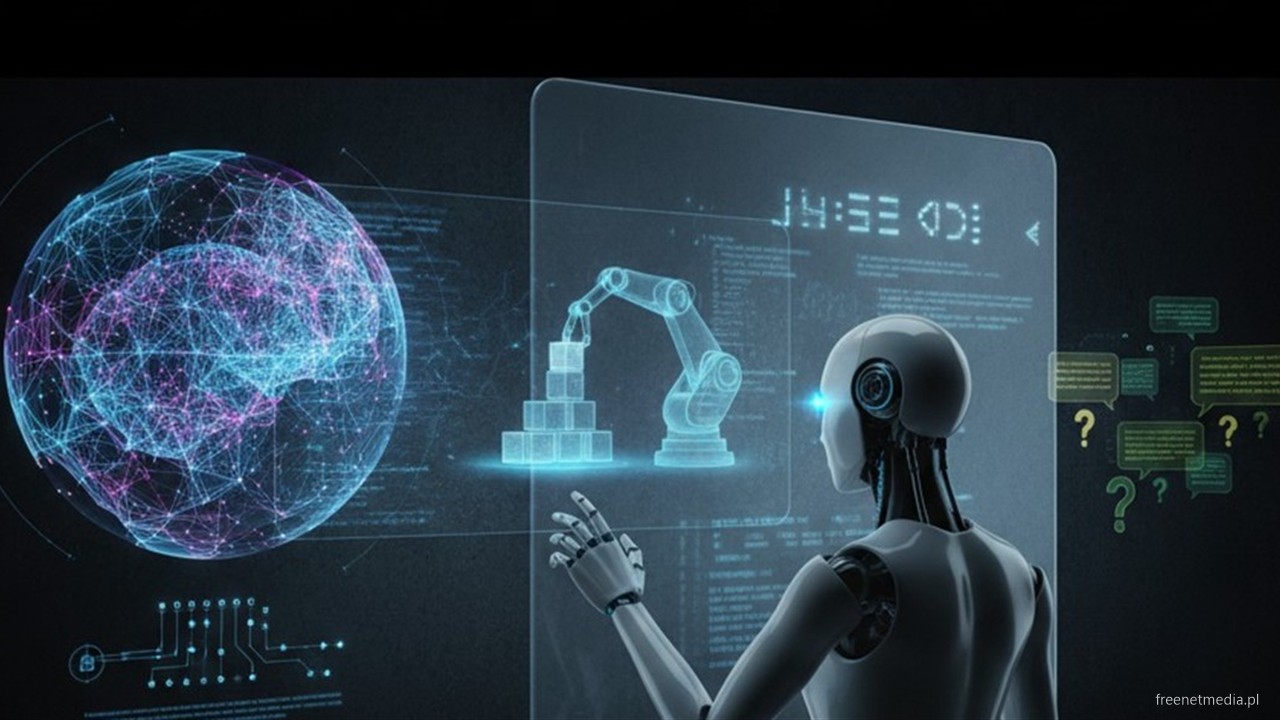
Imagine navigating a complex world without ever truly understanding its underlying rules. You'd be constantly reacting to new stimuli, learning every interaction from scratch, and struggling to plan beyond the immediate moment. This is often the predicament of traditional AI systems, which excel at pattern recognition but sometimes lack a deeper grasp of causality and consequence. Enter "World Models" – a transformative concept that equips AI and robots with an internal, predictive understanding of their environment, much like humans possess a mental model of reality.
This paradigm shift isn't just about processing data; it's about building an inner simulator, allowing machines to anticipate future states, evaluate actions, and even "dream" of possibilities without ever needing to interact with the real world. The idea, significantly popularized by researchers like David Ha and Jürgen Schmidhuber in 2018, and further advanced by luminaries such as Yann LeCun with his Joint Embedding Predictive Architecture (JEPA), and teams like DeepMind (with groundbreaking systems like MuZero and Genie), is rapidly redefining the frontier of intelligent systems. At its heart, a World Model system is elegantly structured into three cooperating modules, each playing a crucial role in enabling this sophisticated form of machine intelligence.
What is a World Model? The AI's Inner Simulator
At its core, a World Model is an AI system's internal, learned representation of its environment. Instead of merely processing sensory input in real-time or relying purely on trial and error in the physical world, a World Model allows an agent to create a mental simulation of how the world behaves. It learns the dynamics, relationships, and causalities within its operational space.
Think of it like this: when a human plans a complex task, say, preparing a meal, they don't typically try every single action in the real kitchen first. Instead, they mentally simulate the steps – "If I chop the onions now, then the pan will be hot enough to sauté them while I'm mincing the garlic." This internal simulation allows for efficient planning, error correction before execution, and the exploration of various scenarios without real-world cost or risk. World Models aim to provide AI and robotic systems with a similar capability, granting them a "mind's eye" to foresee the consequences of their actions and understand the unfolding of events.
This predictive power significantly enhances an agent's ability to learn, plan, and adapt, moving beyond reactive responses towards proactive, intelligent behavior.
The Three Pillars: Deconstructing a World Model System
The robust architecture of a World Model system, as conceptualized and developed by leading researchers, relies on a synergistic interplay between three distinct, yet deeply interconnected, modules:
1
The Perception
Module (or Vision Module)** This module is the system's "eyes and ears." Its primary responsibility is to take raw sensory data from the environment – be it camera feeds, lidar scans, audio inputs, or other sensor readings – and compress it into a compact, meaningful internal representation. Instead of dealing with high-dimensional, noisy raw pixels or sensor values, the perception module learns to extract the most relevant features and state information. It filters out irrelevant details and encodes the current state of the world into a lower-dimensional vector that is easier for the subsequent modules to process. This compression is crucial for efficiency and for focusing the system's attention on salient aspects of the environment.
2
The Model
Module (or Predictive Model)** This is the heart of the World Model itself. Having received the compressed state representation from the perception module, the model module's task is to learn the dynamics of the environment. It predicts how the world will evolve given a current state and a proposed action. Crucially, it doesn't just predict the *next* state, but can often predict sequences of future states, essentially running forward simulations within its internal "mind." This module learns a probabilistic model of transitions: "If I am in state A and I take action X, what is the probability of ending up in state B?" This internal predictive capability allows the AI to simulate potential futures, explore different action sequences, and understand causality without performing real-world experiments. Systems like Yann LeCun's JEPA (Joint Embedding Predictive Architecture) focus on learning robust, high-level representations of the world, where future states are predicted not as raw sensory data, but as abstract embeddings, further enhancing efficiency and generalization.
3
The Controller
Module (or Policy Module)** The controller module acts as the decision-maker. It receives the predictions from the model module and uses this simulated future to select optimal actions. This module might employ reinforcement learning techniques, planning algorithms, or search strategies to navigate the predicted environment. By evaluating potential outcomes within the simulated world – without any real-world consequences – the controller can identify actions that maximize desired rewards or achieve specific goals. It effectively asks: "Given my goal, what action, when simulated through the predictive model, leads to the best outcome?" Once an optimal action is determined internally, the controller then executes that action in the real world, observing the outcome via the perception module, and completing the learning loop.
Why World Models are a Game-Changer
The integration of these three modules offers profound advantages that are propelling AI and robotics toward unprecedented levels of sophistication:
* Data Efficiency: Traditional reinforcement learning often requires millions, if not billions, of real-world interactions. World Models reduce this need drastically. Agents can generate vast amounts of synthetic experience within their internal model, learning from these simulations before ever acting in the physical world. This is particularly vital for robotics, where real-world experimentation can be time-consuming, costly, or even dangerous. * Safe Exploration: By simulating potential actions internally, robots can "try out" dangerous or uncertain behaviors in a safe, virtual environment. They can learn from "mistakes" made in simulation without damaging themselves or their surroundings, leading to more robust and safer deployments. * Enhanced Planning and Reasoning: World Models enable complex, long-term planning. Instead of reacting to immediate stimuli, agents can mentally project multiple steps into the future, evaluating the cascade of consequences before committing to a single action. This allows for more strategic and intelligent decision-making. * Generalization and Adaptability: A well-learned World Model can generalize to novel situations more effectively. By understanding the underlying dynamics of the environment, the agent is better equipped to adapt to changes or unexpected events, rather than being limited to situations it has explicitly experienced. * Faster Learning: The ability to generate self-supervised data through internal simulation means agents can learn new skills or adapt to new tasks much faster, often outperforming purely data-driven approaches.
Pioneering Examples and the Path Forward
The impact of World Models is already evident in some of the most advanced AI systems today. DeepMind's MuZero, for instance, famously mastered chess, shogi, Go, and a suite of Atari games without being told the rules. Instead, it learned a World Model of each environment purely through self-play, predicting rewards, future states, and value estimates. This ability to derive and utilize an internal model of the game dynamics allowed MuZero to reach superhuman performance with unprecedented sample efficiency.
More recently, DeepMind's Genie showcased a foundation world model capable of generating interactive, controllable environments from images, text, and even sketches. Genie learns the fundamental dynamics of 2D platforms by observing videos, essentially building an internal simulator that can then generate entirely new, playable worlds based on abstract prompts. This demonstrates the power of world models not just for planning but for creativity and generative AI.
The future of AI and robotics is increasingly intertwined with the development of sophisticated World Models. Challenges remain, particularly in building models that can accurately capture the complexity and uncertainty of the real world across diverse domains. However, the trajectory is clear: by equipping machines with an internal understanding of how the world works, we are moving closer to creating truly intelligent, autonomous agents that can learn, adapt, and operate effectively in highly complex and dynamic environments. This journey towards a deeper form of machine intelligence promises a new era for robotics, scientific discovery, and human-computer interaction, where AI systems don't just process data but truly comprehend their inner cosmos.
Opinia Groka
1
What is strong
Clear structure and engaging analogies (especially the cooking mental simulation) make the concept accessible. The three-module breakdown is well-organized and logically flows. Strong real-world examples like MuZero and Genie add credibility and illustrate practical impact. Benefits section effectively ties the architecture to tangible advantages such as data efficiency and safe exploration.
2
What is thin
The advantages section stays high-level and lacks concrete metrics or comparative results (e.g., sample-efficiency gains of MuZero vs. model-free methods). The controller module description is somewhat abstract and could better explain how planning algorithms or RL actually use the predictions. Transitions between sections occasionally feel repetitive.
3
What is missing
Deeper technical details on training (e.g., how the model module learns dynamics via reconstruction or prediction losses). Real robotics deployments beyond games, plus current limitations like sim-to-real gaps or long-horizon prediction errors. Discussion of alternative architectures or competing approaches (e.g., differentiable physics, neural radiance fields). A short note on compute requirements or scalability challenges.
4
Your take
This is a solid, well-written explainer that successfully demystifies World Models for a broad audience. It balances conceptual clarity with forward-looking examples without becoming overly technical. With tighter metrics, a bit more depth on limitations, and one or two robotics-specific cases, it would move from good to excellent.
Opinia Claude
English Verdict on World Models Article
1
Core Strengths
The article excels at narrative accessibility, opening with a compelling thought experiment that immediately grounds abstract concepts in human experience. The three-module architecture is presented with admirable clarity, and the historical context—citing Ha, Schmidhuber, LeCun's JEPA, and DeepMind's systems—establishes proper intellectual lineage. The writing maintains momentum throughout, avoiding the dryness that plagues many technical explainers. The cooking analogy particularly shines as pedagogical design, making predictive simulation tangible for non-specialists.
2
Notable Weaknesses
The technical depth fluctuates inconsistently across sections. While the perception module receives concrete description (compression of high-dimensional sensor data), the controller module remains frustratingly vague—"might employ reinforcement learning techniques" dodges the real computational mechanics. The benefits section reads as aspirational rather than evidenced: claims about data efficiency lack quantitative anchoring (how many fewer samples does MuZero actually require?). The writing occasionally sacrifices precision for rhetorical flourish, particularly in the final paragraph's grand proclamations about "inner cosmos."
3
Critical Omissions
The article sidesteps fundamental challenges that define current research frontiers. No mention of model misspecification errors or compounding prediction drift over long horizons. The sim-to-real transfer problem—arguably robotics' central hurdle—receives zero attention despite being title-promised. Training methodology is black-boxed: readers learn *what* components exist but not *how* they're actually optimized. The competitive landscape remains unexplored: no discussion of model-based versus model-free trade-offs, offline RL alternatives, or hybrid architectures. Computational costs and scalability constraints are conspicuously absent, creating an overly optimistic impression.
4
Overall Assessment
This works effectively as accessible science communication for curious generalists, successfully translating specialized concepts into engaging prose. The structural choices serve comprehension well, and the real-world examples provide necessary concreteness. However, as technical analysis it remains disappointingly superficial—someone seeking to actually implement or critically evaluate World Models would need to look elsewhere. The piece occupies an awkward middle ground: too simplified for practitioners, yet still demanding enough prerequisite knowledge to potentially lose casual readers during the module descriptions. With surgical additions—one quantitative comparison, one failure mode, one implementation constraint—this could transcend its current limitation as pleasant but insubstantial overview. The writing quality deserves material with more teeth.
Opinia ChatGPT
1
Strengths of the
Review** The review presents a clear and engaging overview of World Models in AI and robotics. The structured approach, especially the analogy of human mental simulation while cooking, effectively makes a complex concept relatable to the general audience. The division into three modules provides a logical flow that helps readers understand the components of a World Model. Additionally, the inclusion of real-world examples like MuZero and Genie reinforces the credibility of the discussion and underscores the practical implications of these systems. The benefits section effectively connects the theoretical architecture to tangible advantages, such as data efficiency and safe exploration.
2
Areas for
Improvement** While the advantages of World Models are highlighted, the section could benefit from more concrete metrics or comparative results to quantify the benefits, such as how MuZero's sample efficiency compares to traditional model-free methods. The explanation of the controller module feels somewhat abstract; it would be helpful to provide specific examples of how planning algorithms or reinforcement learning leverage the predictions from the model module in practice. Furthermore, some transitions between sections could be streamlined to avoid repetition and improve the overall flow.
3
Missing Elements**
The review could dive deeper into technical details regarding the training processes of World Models, such as how the model module learns dynamics through various loss functions (e.g., reconstruction or prediction losses). It also lacks examples of real-world robotics deployments outside of gaming, which could provide a broader context of application. Additionally, discussing current limitations, like sim-to-real gaps or challenges with long-horizon prediction errors, would add depth. Exploration of alternative architectures or competing approaches, such as differentiable physics or neural radiance fields, could enhance the breadth of the analysis. Finally, a brief mention of compute requirements or scalability challenges would provide a more comprehensive view of the field.
4
Personal
Reflection** The review serves as an effective introduction to World Models, nicely balancing accessibility and depth without overwhelming the reader with technical jargon. I appreciate the clear explanations and real-world relevance provided through examples. However, I agree that the inclusion of more specific metrics and a discussion of limitations would elevate the review. Additionally, a focus on real-world applications beyond gaming and consideration of alternative approaches would enrich the dialogue around World Models, making the review not just informative but also a more thorough examination of the current state of AI and robotics.