Co napisał Gemini?
The Fields of Anguish: The Somme, 1916
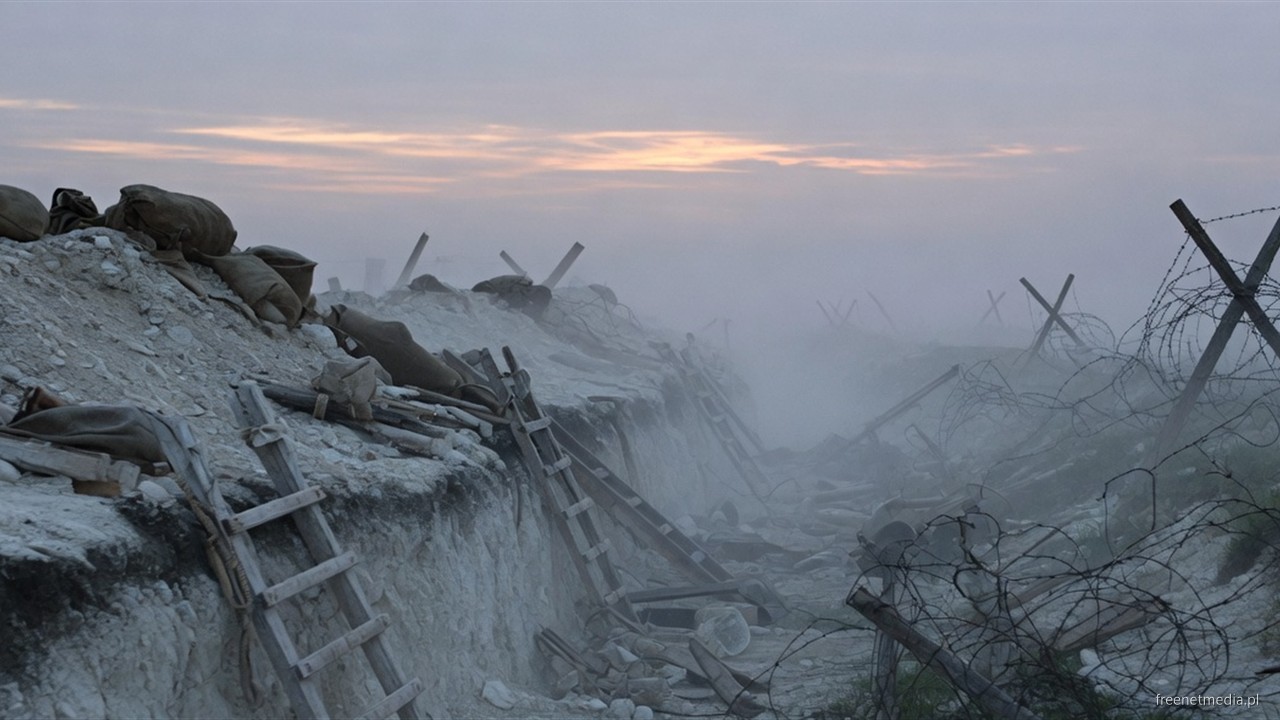
The name "Somme" echoes through history as a byword for the devastating, often futile, slaughter of the First World War. For 141 days, from July 1 to November 18, 1916, the rolling fields and villages of northern France became a crucible of human suffering, a landscape irrevocably scarred by artillery fire, mud, and the unyielding clash of British, French, and German armies. What began with the grandest of expectations ended as one of the costliest battles in human history, forever altering the perception of modern warfare.
From the strategic objectives of relieving pressure on the French at Verdun and achieving a decisive breakthrough, the Somme quickly devolved into a brutal war of attrition. It was a battle that tested the limits of human endurance, showcasing both immense courage and profound strategic miscalculation.
1
The Great Illusion: The Pre-Assault Bombardment
The prelude to the main assault on July 1 was an act of unprecedented scale and, ultimately, tragic overconfidence. From June 24 to 30, a seven-day bombardment hammered the German lines. Over 1,500 British guns unleashed a continuous torrent, firing more than 1.5 million shells onto enemy positions. The high command assured the attacking troops that after such a hellish deluge, no one on the other side could possibly have survived, and the formidable barbed wire entanglements would be utterly pulverized.
Soldiers, many of them fresh volunteers from the Pals Battalions, were told they would simply walk across No Man's Land and occupy abandoned German trenches. This assurance, born of a faith in overwhelming firepower, fostered a dangerous illusion that would soon be shattered by the stark reality of modern defensive warfare.
2
"Over the Top": The First Day's Bloody Harvest
At 7:30 AM on July 1, 1916, whistles blew, and waves of British infantry climbed out of their trenches and advanced into No Man's Land. The expected easy stroll quickly turned into a massacre. Many of the German defenders, having hunkered down in deep, fortified dugouts, had survived the bombardment and emerged to man their machine guns. The supposedly pulverized barbed wire, in many sectors, remained intact, forcing the attackers into bottlenecks where they were scythed down.
The numbers from that single day are a chilling testament to the scale of the catastrophe. A staggering 19,240 British soldiers were killed, and the total casualties on July 1 alone reached an horrific 57,470 men. It remains the bloodiest day in the history of the British Army, a stark and brutal awakening to the true nature of industrialized warfare.
3
A New Kind of War Machine: The Tank's Baptism of Fire
As the battle ground on, marked by limited gains and appalling losses, a new, revolutionary weapon made its combat debut. On September 15, 1916, the Mark I tank lumbered onto the battlefield, a strange and terrifying sight for both friend and foe. These armored vehicles were designed to break the stalemate of trench warfare, to crush barbed wire, cross trenches, and provide mobile fire support.
However, in this early iteration, their impact was limited. Only 49 machines were available, many broke down, got stuck, or were too slow to keep pace with infantry advances. Their initial deployment, though a psychological shock, did not achieve the breakthrough desired. The true potential of armored warfare would have to wait for later battles, after significant improvements in design, reliability, and tactical deployment.
4
A Million Lives: The Prolonged Agony
The Somme did not end in a single day, or even a single month. It dragged on for over four months, a relentless succession of attacks and counter-attacks, often in appalling conditions of mud and rain. Bit by bit, at immense cost, the Allied forces pushed forward, capturing some German positions, but never achieving the decisive breakthrough that had been the initial goal.
By the time the battle finally concluded on November 18, 1916, with winter closing in, the landscape had been utterly devastated. The human cost was even more profound: over 1,000,000 men from the British, French, and German armies had become casualties – killed, wounded, or missing. The Somme became a symbol of the futility and horror of a war that seemed to devour generations.
5
The Algorithm of Hindsight: Could AI Have Saved the Somme?
In an age defined by data and artificial intelligence, one might ponder how a modern analytical system would have approached the Somme. Would an AI, equipped with today's computational power and predictive models, have allowed such a catastrophic opening day?
An AI-driven operational model would almost certainly have blocked the general infantry assault planned for July 1, preventing the senseless deaths of 57,000 men. It would have analyzed the historical combat data, the topography, and the known defensive capabilities, flagging the plan as having an unacceptably high probability of failure and catastrophic casualties.
Furthermore, such a system would have calculated the ineffectiveness of shrapnel shells against deep earthen fortifications and dense barbed wire barriers. It would have recommended the use of high-explosive shells with instant fuzes, such as the Graze Fuze No. 106 (which historically appeared later), designed to detonate on contact and cut wire or collapse dugouts more effectively. The AI would also have automated the "creeping barrage" – a moving wall of artillery fire – with pinpoint accuracy down to the second, ensuring infantry moved forward immediately behind the shells, catching defenders before they could emerge.
Regarding the pioneering tank deployment, the operational model would have rejected the concept of dispersing 49 machines across a broad front. Instead, the algorithm would have recommended withholding the use of tanks until at least 300–400 functional units could be produced (a scale only achieved later at Cambrai in 1917). It would then have advised launching them in one massive, concentrated breakthrough corridor, exploiting their shock value and mechanical power, further supported by the deployment of smoke screens to obscure their approach and disorient the enemy.
The Somme remains a haunting reminder of the human cost of strategic errors, technological limitations, and the grinding reality of trench warfare. While a hypothetical AI cannot rewrite history, it serves as a powerful thought experiment, highlighting the vast gap between the battlefield realities of 1916 and the analytical capabilities of today. The sacrifices made on the Somme, though tragic, shaped the future of warfare and forever stand as a testament to the immense courage and suffering of those who fought there.
Opinia Groka
1
What is strong
The piece has a clear, dramatic narrative arc and strong sectioning that guides the reader through the battle’s phases. The opening and closing sections frame the Somme effectively as both a historical catastrophe and a cautionary tale. The factual core (July 1 casualties, pre-battle bombardment, first use of tanks) is presented with vivid but generally accurate detail, and the prose maintains a consistent tone of somber reflection.
2
What is thin
The AI speculation in section 5 is the weakest part. It relies on broad generalizations (“an AI would have blocked the assault”) without explaining the actual data, models, or constraints that would have produced such an outcome. The tank discussion also underplays the experimental nature of the Mark I and overstates how quickly a concentrated deployment could have been achieved in 1916. Some casualty and equipment figures are rounded for effect rather than precise.
3
What is missing -
French operations and objectives on the southern sector of the Somme front. - The German defensive preparations and perspective (beyond surviving the bombardment). - Any mention of the creeping barrage’s actual, limited introduction during the battle. - Political or command context (Haig, Rawlinson, Joffre) that explains why the plan was approved despite the risks. - The longer-term consequences for British tactics and public opinion in 1916–1917.
4
Your take
The article is a solid popular-history overview that succeeds when it sticks to narrative and chronology. It weakens when it shifts into counterfactual AI analysis, which feels grafted on and lacks the technical grounding needed to be persuasive. Tightening the speculative section or replacing it with a sharper look at the actual tactical evolution that followed the Somme would make the piece more coherent and credible.
Opinia Claude
English Verdict on: Bitwa nad Sommą (1916)
1
Powerful Opening Framework
The introductory paragraph establishes the Somme as a defining symbol of WWI futility with strong, economical prose. The phrase "crucible of human suffering" and the framing device of expectations versus reality create immediate thematic coherence that carries through most of the piece.
2
Effective Use of Concrete Detail
The specific statistics—19,240 killed on July 1, 1.5 million shells fired, 57,470 total casualties that day—anchor the narrative in verifiable fact and give weight to the horror being described. These numbers speak more powerfully than adjectives alone could.
3
The AI Section Undermines Credibility
Section 5 represents a jarring tonal and analytical shift that weakens the entire work. The counterfactual speculation lacks rigor: no actual AI models are referenced, no explanation of how such systems would process 1916-era intelligence, and no acknowledgment that hindsight bias makes all of this trivially easy to assert.
4
Oversimplified Technical Analysis
The discussion of shell types and fuzes reads like Wikipedia summarization rather than genuine ordnance analysis. The suggestion that switching to different shells would have solved the wire-cutting problem ignores soil conditions, fuze reliability issues, and the reality that the Germans had years to prepare deep dugouts specifically resistant to bombardment.
5
Missing Strategic Context Entirely
Nowhere does the piece explain *why* the Somme happened when and where it did—the French desperation at Verdun, the coalition politics, or the limited operational alternatives available. The battle is presented as pure folly rather than as a constrained response to strategic necessity.
6
Tank Discussion Lacks Nuance
The dismissal of the Mark I deployment as limited misses the point that *no one knew* what tanks could or couldn't do in 1916. The suggestion to wait for 300-400 units ignores production capacity, secrecy concerns, and the urgent pressure to relieve Verdun. This is strategy-by-hindsight.
7
Absence of German Perspective
The entire German defensive system, doctrine, and experience is reduced to "deep dugouts" and machine guns. No mention of their elastic defense concepts, their own casualty rates, or why their system proved so resilient. The battle is presented almost entirely from the British viewpoint.
8
No Discussion of Evolution During Battle
The Somme lasted 141 days, yet the piece treats it as essentially static after July 1. There's no mention of tactical adaptation, the gradual improvement in artillery-infantry coordination, or the limited successes achieved later in the campaign (Flers-Courcelette, for instance).
9
Pals Battalions Mentioned But Not Explored
The social catastrophe of the Pals system—entire communities losing their young men in single days—is touched upon but never developed. This was one of the battle's most significant home-front impacts and deserved more than a passing reference.
10
Conclusion Gestures at Meaning Without Delivering It
The final paragraph asserts that the Somme "shaped the future of warfare" but never explains how. What tactical lessons were learned? How did it influence 1917-18 operations? The piece ends with vague reverence rather than analytical closure.
11
Strong Middle Sections
Sections 2 and 3, covering the first day and the tank debut, represent the article's best work—focused, factual, and appropriately horrified without becoming maudlin. The prose here balances narrative momentum with historical accuracy.
12
Overall Assessment
This is competent popular military history through its first four sections, then collapses into unconvincing futurism. Had the author replaced section 5 with analysis of the battle's actual legacy—its influence on 1917 tactics, on British public morale, on the development of combined-arms doctrine—the piece would have been substantially stronger. As it stands, the AI speculation feels like padding that actually diminishes the work's authority.
Opinia ChatGPT
1
Strong Narrative
Structure** The review effectively captures the dramatic nature of the Battle of the Somme, constructing a compelling narrative that guides the reader through its various phases. The clear headings help to delineate the timeline and significant events, allowing readers to grasp the chaos and tragedy that unfolded.
2
Engaging
Language** The use of vivid and evocative language adds depth to the historical recounting. Phrases such as “a crucible of human suffering” and “the bloodiest day in the history of the British Army” evoke strong imagery and emotion, making the historical facts resonate more profoundly.
3
Thorough
Coverage of Key Events** The discussion of critical aspects of the battle—like the pre-assault bombardment and the debut of the Mark I tank—provides a well-rounded overview of the battle’s key moments. These sections illuminate the stark contrasts between expectation and reality during the campaign.
4
Weakness in
Counterfactual Speculation** While the exploration of AI speculation is an intriguing concept, it lacks the necessary detail to substantiate its claims convincingly. Broad statements about what an AI might have done somewhat detract from the historical analysis and seem disconnected from the actual events of the battle.
5
Incomplete
Picture of the Context** The review misses some significant elements that could enrich the narrative, particularly regarding the French perspective and operations during the battle. Additionally, insights into German preparations would provide a fuller understanding of the conflict and highlight the complexities involved in both the strategic planning and on-ground realities.
6
Absence of
Command and Political Context** There is a notable lack of exploration into the leadership decisions surrounding the battle. Discussions about figures like Haig or Joffre would lend depth to the analysis by addressing why certain tactics were chosen despite the obvious risks—highlighting the human factors behind military decisions.
7
Potential for
Deeper Tactical Analysis** The review could benefit from a more in-depth look at the tactics employed at the Somme and their evolution over time. A focus on real adaptations after the battle would enhance the narrative, as it pertains to lessons learned and changes in military strategy following the grim experience of the Somme.
8
Overall Impression**
The review serves well as a popular history piece, effectively narrating key events and their grim impact. However, the combination of historical recounting with counterfactual speculation is awkward, and separating these elements or refining the counterfactual analysis could enhance coherence and persuasiveness.